🚀 Human Spaceflight Systems: International Space Station (ISS) Systems Engineering
This technical monograph evaluates manned orbital station architecture, life-support chemical engineering, reusable spacecraft aerothermodynamics, spacesuit biomechanics, and space medicine under the editorial leadership of Annamae Turner.
The Colossus of Low Earth Orbit: Twenty-Five Years of Continuous Human Habitation
Orbiting approximately 420 kilometers above Earth at a blistering orbital velocity of 27,600 kilometers per hour (7.66 km/s), the **International Space Station (ISS)** represents the most complex, expensive, and multinational engineering structure ever constructed by the human species. Measuring 109 meters from end to end—spanning the length of an entire American football field—and massing approximately 450 metric tons, the ISS has maintained continuous, uninterrupted human habitation since Expedition 1 docked in November 2000.
The construction of the ISS was an unprecedented feat of orbital logistics and extravehicular robotics:
– It required over forty dedicated assembly flights conducted primarily by the American Space Shuttle fleet and Russian Proton/Soyuz launch vehicles.
– Astronauts and cosmonauts conducted over 250 spacewalks totaling more than 1,600 hours to assemble pressurized modules, connect high-voltage power conduits, install ammonia thermal radiator loops, and erect the massive Integrated Truss Structure (ITS).
– Combining modules built by NASA, Roscosmos, ESA, JAXA, and CSA into a single hermetically unified habitable habitat volume of 916 cubic meters required unifying disparate engineering standards—reconciling metric and imperial fabrication tolerances, Russian 28-volt DC and American 120-volt DC power architectures, and distinct life support gas pressurization doctrines into a seamless life-sustaining sanctuary.
Environmental Control and Life Support Systems (ECLSS): Closing the Biological Loop
Sustaining an international crew of seven astronauts permanently in the vacuum of space without continuous, prohibitively expensive water and oxygen resupply from Earth requires a marvel of chemical and environmental engineering: the **Environmental Control and Life Support System (ECLSS)**.
ECLSS is responsible for four life-critical functions:
1. **Atmospheric Composition & Total Pressure Control:** Maintaining a sea-level equivalent atmosphere of 101.3 kPa (14.7 psi) composed of 78% nitrogen and 21% oxygen, preventing the decompression sickness and fire hazards associated with pure-oxygen architectures.
2. **Carbon Dioxide Removal:** Astronauts continuously exhale carbon dioxide (CO2). If CO2 concentrations exceed 0.5% (3.8 mmHg), crew members experience cognitive impairment, headaches, and acidosis. To prevent this, the **Carbon Dioxide Removal Assembly (CDRA)** utilizes regenerable thermal swing zeolite molecular sieves that scrub CO2 from the cabin air.
3. **Oxygen Generation Assembly (OGA):** Utilizing solid polymer electrolyte electrolysis, OGA splits water molecules ($2H_2O \xrightarrow{} 2H_2 + O_2$), releasing pure, breathable oxygen gas into the cabin atmosphere.
4. **The Sabatier Methanation Reactor:** Rather than venting the byproduct hydrogen gas and scrubbed CO2 into space, the Sabatier reactor mixes them over a ruthenium catalyst at 400°C:
\[ CO_2 + 4H_2 \xrightarrow{400^\circ C + Ru} CH_4 + 2H_2O \]
The synthesized water ($H_2O$) is fed back into the OGA to generate more oxygen, while methane ($CH_4$) is vented overboard, achieving substantial closed-loop mass conservation.
| ISS Life Support Subsystem | Primary Chemical Reactants | Output Products | Recycling Efficiency / Metric | Operational Significance |
|---|---|---|---|---|
| Oxygen Generation (OGA) | Potable Water (H2O) | Breathable O2 + H2 Byproduct | Electrolysis split | Sustains 7-person metabolic breathing |
| Carbon Dioxide Removal (CDRA) | Cabin Air (CO2 + H2O) | Purified Air + Desorbed CO2 | Thermal swing zeolite sieves | Prevents hypercapnia and cognitive decline |
| Sabatier Methanation | CO2 (CDRA) + H2 (OGA) | Water (H2O) + Methane (CH4) | Catalytic loop closure | Recovers water from exhaled carbon dioxide |
| Urine Processor (UPA) | Crew Urine & Flush Water | Clean Water Distillate | Vapor compression centrifuge | Separates water from urea in zero-gravity |
| Brine Processor (BPA) | Concentrated Urine Brine | Potable Water Vapor | 98% Total Water Recovery | Minimizes Earth water launch resupply mass |
Water Recovery System (WRS): 98% Hydration Recycling Efficiency
Perhaps the most celebrated engineering achievement of the ISS ECLSS is the **Water Recovery System (WRS)**. In deep space, water is life, yet water masses 1 metric ton per cubic meter, making continuous water launches financially unsustainable.
The WRS recovers potable drinking water from three primary crew effluent streams:
– **Atmospheric Humidity Condensate:** Capturing moisture exhaled by astronaut breath and perspiration via cabin condensing heat exchangers.
– **Crew Urine:** Processed by the **Urine Processor Assembly (UPA)**. Because boiling urine in microgravity results in foam that fouls distillation boilers, UPA utilizes a spinning **Vapor Compression Distillation (VCD)** centrifuge: centrifugal acceleration forces liquid urine against heated boiler walls, vaporizing water vapor while leaving behind a concentrated toxic urea brine.
– **The Brine Processor Assembly (BPA):** Deployed in 2021, BPA utilizes specialized vacuum membrane distillation sheets that extract residual water from the concentrated brine.
The recovered water distillate passes through catalytic oxidation reactors, multi-filtration beds, and iodine microbial stabilization units. Today, the ISS water recycling loop achieves a staggering **98% recovery efficiency**—producing water that is chemically purer than terrestrial municipal tap water, proving the closed-loop life-support viability required for three-year human round-trips to Mars.
Integrated Truss Structure and Solar Photovoltaic Power Systems
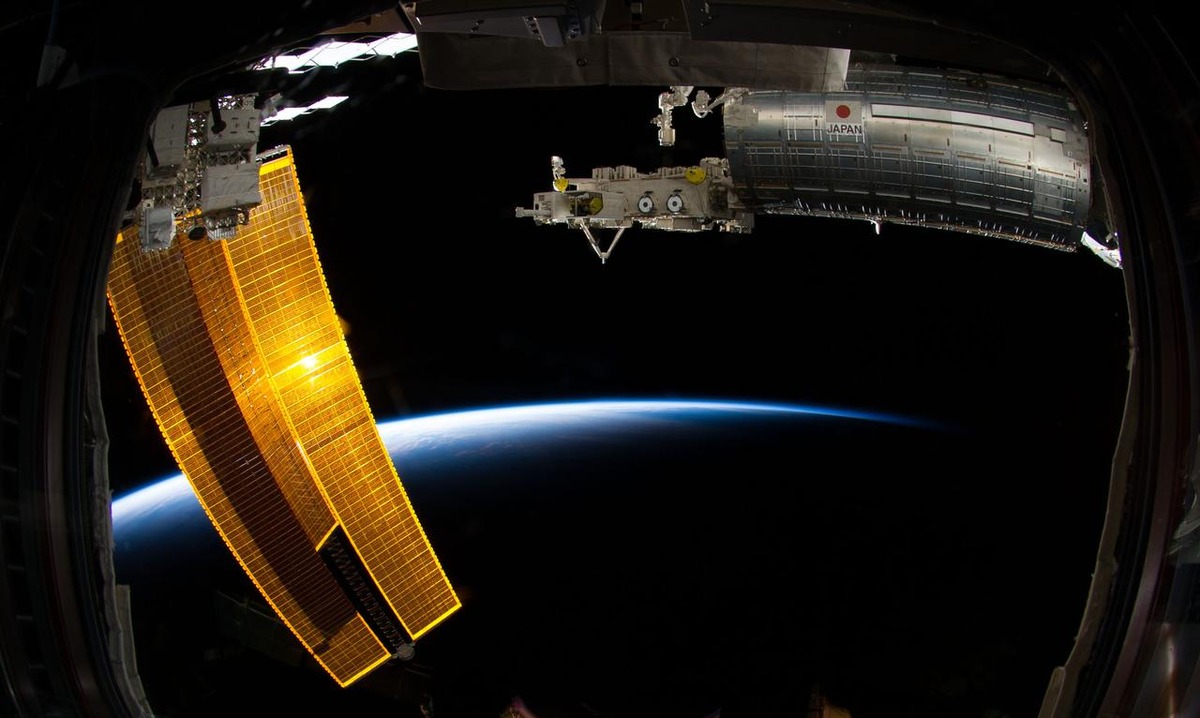
The structural backbone of the ISS is the **Integrated Truss Structure (ITS)**—a 108.5-meter segmented aluminum and titanium truss that acts as the physical mounting framework for solar array wings, thermal radiators, external experiment platforms, and the Mobile Servicing System rail track.
Electrical power generation is managed by eight colossal **Solar Array Wings (SAWs)**:
– Spanning 73 meters across and covering an area of 2,400 square meters, the primary arrays utilize silicon photovoltaic cells protected by Kapton backing.
– In recent years, NASA has augmented power generation by deploying **iROSA (ISS Roll-Out Solar Arrays)**—flexible composite solar blankets that unroll like tape measures, utilizing high-efficiency triple-junction gallium arsenide cells that generate over 215 kilowatts of total electrical power.
– To prevent solar cells from tearing as the station orbits through the day-night boundary every 90 minutes, **Solar Alpha Rotary Joints (SARJs)** continuously rotate the colossal wings 360 degrees every orbit, tracking the Sun with astronomical precision.
Power storage is managed by twenty-four high-density **Lithium-Ion Battery ORUs** (which replaced the station’s original nickel-hydrogen batteries), storing electrical energy to power life-support systems during the 35-minute eclipse phase of each 90-minute orbit.
Active Thermal Control System (ATCS): Ammonia Radiator Loops in Microgravity
Because the vacuum of space is an absolute thermal insulator (eliminating heat convection and conduction), shedding excess heat is one of the most severe challenges aboard the ISS. Between avionics computers, electrical power conversion boxes, science experiment incubators, and human metabolic body heat, the station continuously generates over **70 kilowatts of waste heat**.
If this heat were not continuously rejected into deep space, internal cabin temperatures would skyrocket past 60°C within hours, cooking avionics and killing the crew.
To dissipate this thermal load, the station utilizes the **Active Thermal Control System (ATCS)**:
1. **Internal Thermal Loop (Water):** Water is circulated through cooling cold plates mounted directly beneath electronic racks and cabin heat exchangers, absorbing internal heat safely without toxic chemical exposure to the crew.
2. **Interface Heat Exchangers:** The water loop transfers its thermal energy across titanium heat exchangers to the external cooling loop.
3. **External Thermal Loop (Liquid Ammonia):** Liquid anhydrous ammonia ($NH_3$) is utilized because it possesses a low freezing point (-77.7°C) and exceptionally high specific heat capacity. Motorized pumps circulate pressurized ammonia across the truss to seven massive **Deployable Thermal Radiator Panels**.
4. **Radiative Rejection:** Spanning over 50 meters, the radiators face perpendicular to the Sun, radiating heat directly into the freezing -270°C deep space cosmic microwave background as infrared thermal photons.
Microgravity Fluidics, Two-Phase Flows, and Capillary Mechanics
Operating complex hydraulic, propellant, and thermal systems aboard the ISS requires mastering fluid physics in **Microgravity ($10^{-6}\text{ G}$)**.
On Earth, gravity drives density-driven buoyancy: hot air rises, cold water sinks, and gas bubbles naturally float to the top of a liquid container. In microgravity, **gravity-driven buoyancy and hydrostatic pressure vanish completely**:
– Fluid dynamics is dominated entirely by **Surface Tension, Capillarity, and Viscous Shear**:
– Boiling water produces a single, stagnant vapor bubble that adheres to the heater surface, insulating it and causing catastrophic heater burnout (critical heat flux collapse).
– Air bubbles remain suspended inside water pipes, forming vapor locks that destroy centrifugal pumps.
To control fluids in microgravity, ISS systems engineer specialized capillary architectures:
– **Phase Separator Centrifuges:** Physically spin fluid mixtures to generate artificial gravity, separating gas from liquids via centrifugal sedimentation.
– **Capillary Vanes and Screen Channels:** Exploiting the Young-Laplace equation across micro-machined porous channels to passively draw liquids toward tank outlets via surface wetting forces alone, eliminating mechanical pumps and enabling reliable fuel delivery for orbital thrusters.
Guidance, Navigation, and Control (GNC): Control Moment Gyroscopes and Reboost Dynamics
Although the ISS orbits in ‘space’, the thermosphere at 420 kilometers altitude is not a perfect vacuum; it contains a trace atmosphere of atomic oxygen. Atmospheric drag exerts a continuous decelerating force on the station’s colossal 2,400-square-meter surface area, causing the station to lose approximately **100 meters of altitude every single day**.
If left uncorrected, orbital decay would cause the station to deorbit and burn up in the lower atmosphere within two to three years.
To counteract orbital drag and manage station orientation without consuming finite rocket propellant:
– **Control Moment Gyroscopes (CMGs):** Mounted on the Z1 truss are four massive 100-kilogram steel flywheels spinning at 6,600 RPM inside motorized two-axis gimbals. By tilting the gimbals, the CMGs exert gyroscopic precession torques on the station, maintaining three-axis attitude stability without firing a single gram of rocket fuel.
– **Orbital Reboost Burns:** To restore lost orbital altitude, the station periodically ignites the hypergolic rocket thrusters of docked Russian Progress or American commercial Cygnus cargo spacecraft, imparting 1 to 2 meters per second of delta-v to push the station back into its nominal 420-kilometer circular orbit.
Robotic Manipulator Kinematics: Canadarm2, Dextre, and Berthing Dynamics
A foundational technology enabling the construction and operational maintenance of the International Space Station is the **Mobile Servicing System (MSS)**, engineered by MDA and the Canadian Space Agency (CSA):
– **Canadarm2 (Space Station Remote Manipulator System, SSRMS):** A 17.6-meter-long robotic arm fabricated from carbon-fiber thermoplastic composite, featuring seven motorized rotary joints that grant seven degrees of kinematic freedom. Canadarm2 can maneuver massive 116-ton payloads (such as Space Shuttle orbiters and pressurized modules) with millimeter positional precision.
– **Walking End-Over-End:** Unlike fixed factory robot arms, Canadarm2 possesses symmetrical Latching End Effectors (LEEs) on both ends, allowing it to ‘walk’ end-over-end across the station hull by alternating its anchor grip between Power and Data Grapple Fixtures (PDGFs) distributed across the truss.
– **Dextre (Special Purpose Dexterous Manipulator):** A dual-armed robotic handyman equipped with force-moment sensors and tool sockets, capable of replacing external orbital replacement units (ORUs) and battery packs autonomously via ground control from Houston and Montreal, slashing the necessity for high-risk astronaut spacewalks.
Orbital EVA Repair Campaigns: AMS-02 Thermal Cooling Overhaul
The supreme demonstration of in-orbit extravehicular servicing occurred between November 2019 and January 2020 during the four-part spacewalk campaign to repair the **Alpha Magnetic Spectrometer (AMS-02)**—a 2-billion-dollar particle physics detector searching for dark matter and primordial antimatter mounted on the ISS truss.
AMS-02 was engineered as an unserviceable experiment with permanently welded stainless steel carbon dioxide cooling lines. When three of its four cryogenic cooling pumps failed after eight years of operation:
– Astronauts Luca Parmitano (ESA) and Drew Morgan (NASA) executed orbital surgery: cutting through structural carbon-fiber shields, severing eight stainless steel tubes without generating metal debris, and using specialized swaging tools to splice a newly designed Upgraded Tracker Pump Package (UTPP) into the cryogenic system.
– This historic repair restored AMS-02’s thermal stability, demonstrating that with specialized bespoke tooling and rigorous neutral buoyancy simulation, astronauts can perform complex fluidic and electronic overhauls on space systems never designed for human servicing.
Commercial Transition, Private Space Stations, and Deorbit Logistics
As the ISS approaches its third decade of operation, NASA and its international partners have approved operational extensions through 2030. However, structural fatigue on the oldest Russian and American modules (Zarya, Unity, and Zvezda)—induced by hundreds of thousands of thermal expansion cycles across 175,000 orbital sunrises and sunsets—means the station cannot operate indefinitely.
The future of low Earth orbit is transitioning toward **Commercial LEO Destinations (CLD)**:
– Commercial aerospace companies (such as Axiom Space, Vast, and Starlab) are developing privately owned modular space stations, utilizing inflatable habitat structures and modernized life support architectures.
– NASA will transition from owning and operating station infrastructure to purchasing astronaut research berths and orbital laboratory time as an institutional customer.
In early 2031, the International Space Station will execute its final, historic mission: **Controlled Destructive Deorbit**. A high-thrust commercial deorbit vehicle (awarded to SpaceX) will fire its rocket engines in a powerful retrograde burn, guiding the 450-ton station into a targeted re-entry corridor over the remote South Pacific Oceanic Uninhabited Area—**Point Nemo (The Spacecraft Graveyard)**—bringing an epic, half-century chapter of multinational human cooperation and orbital science to a triumphant, controlled conclusion.