🚀 Robotic Spacecraft Engineering: Deep Space Ion Propulsion and Autonomous Navigation
This technical monograph provides in-depth documentation covering deep-space probe architecture, autonomous telemetry, nuclear/electric propulsion physics, and planetary science under the editorial direction of Annamae Turner.
The Rocket Equation Tyranny: Why Chemical Rockets Hit a Physical Wall
At the foundation of aerospace engineering lies Konstantin Tsiolkovsky’s classical **Ideal Rocket Equation**:
\[ \Delta v = I_{sp} g_0 \ln\left(\frac{m_0}{m_f}\right) \]
Where $\Delta v$ is the total velocity change, $I_{sp}$ is the specific impulse (the fuel efficiency of the engine, measured in seconds), $g_0$ is standard gravity, $m_0$ is initial wet mass, and $m_f$ is final dry mass.
Because the propellant mass fraction appears inside a logarithmic term, achieving high velocity changes with conventional chemical rockets demands exponentially massive quantities of propellant. Chemical propulsion (such as liquid hydrogen/liquid oxygen or hypergolic hydrazine) is fundamentally limited by the chemical bond energy released during combustion. The absolute theoretical maximum specific impulse of chemical rocketry hovers between 300 and 460 seconds.
For ambitious interplanetary missions requiring complex orbital captures, orbital plane changes, and rendezvous with multiple disparate celestial bodies, chemical propulsion becomes mathematically unviable: the spacecraft would have to be composed of 95% propellant, leaving virtually no mass margin for scientific cameras, computers, or antennas.
The revolutionary escape from this chemical tyranny is **Electric Propulsion**, specifically **Gridded Ion Thrusters and Hall-Effect Thrusters**, which decouple energy generation from propellant mass, achieving fuel efficiencies ten to twenty times greater than the finest chemical rocket engines ever built.
The Physics of Gridded Electrostatic Ion Thrusters
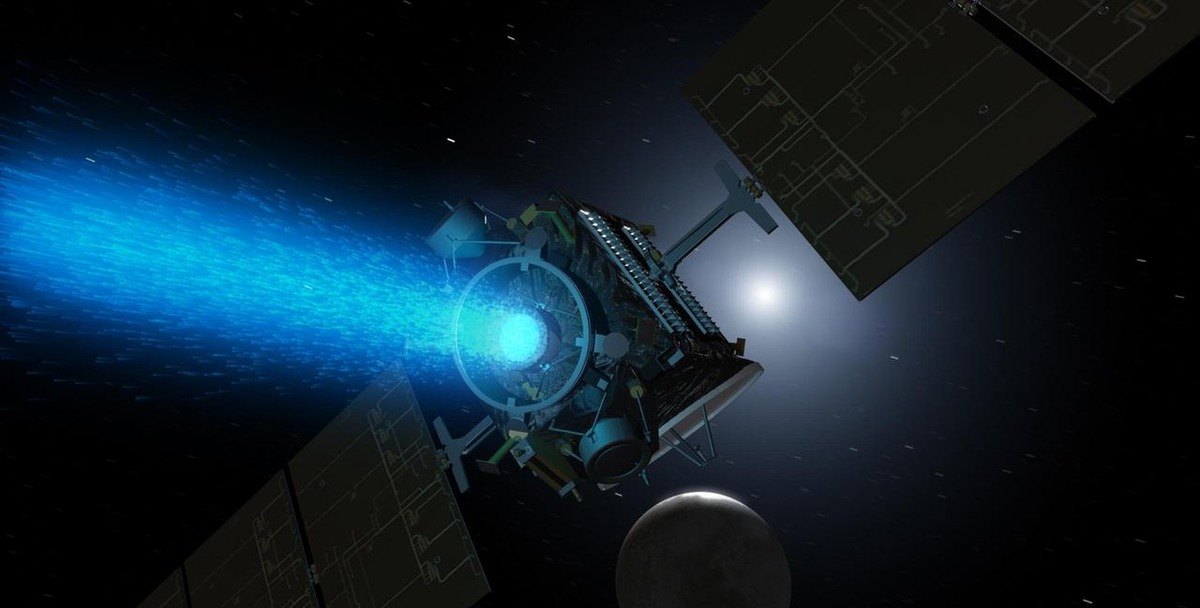
The operational physics of a gridded electrostatic ion engine (such as NASA’s NSTAR thruster, flown on Deep Space 1 and the Dawn spacecraft) is an elegant mastery of plasma physics and high-voltage electromagnetism:
1. **Propellant Gas Ingestion:** An inert, heavy noble gas—primarily **Xenon (Xe)**, chosen for its high atomic mass (131.3 u), low ionization energy (12.1 eV), and ease of compact supercritical storage—is injected into a cylindrical discharge chamber.
2. **Electron Bombardment Ionization:** A hollow cathode emits a stream of energetic electrons, which are magnetically confined inside the chamber by samarium-cobalt permanent magnets. When these electrons collide with neutral xenon atoms, they strip away valence electrons, creating a dense plasma of positively charged Xenon ions ($Xe^+$):
\[ e^- + Xe \xrightarrow{} 2e^- + Xe^+ \]
3. **Electrostatic Grid Acceleration:** At the exit of the discharge chamber are two precision-aligned multi-aperture molybdenum grids:
– The upstream **Screen Grid** is charged to a high positive potential (+1,000 to +1,500 Volts).
– The downstream **Accelerator Grid** is charged to a negative potential (-200 to -500 Volts).
The intense electrostatic potential gradient between the grids accelerates the positive xenon ions through thousands of tiny apertures, expelling them at staggering exhaust velocities of **30,000 to 50,000 meters per second (Mach 100+)**—compared to chemical rocket exhaust velocities of merely 3,000 to 4,500 m/s.
4. **Plasma Neutralization:** As the high-velocity ion beam exits the spacecraft, an external neutralizer cathode injects electrons into the exhaust plume. This neutralization is mandatory: if the beam were un-neutralized, the spacecraft would rapidly accumulate a massive negative electrical charge, which would attract the positively charged ion beam back toward the hull, canceling forward thrust and eroding spacecraft surfaces.
| Propulsion Technology | Exhaust Velocity | Specific Impulse (Isp) | Thrust Level | Primary Mission Domain |
|---|---|---|---|---|
| Chemical (LOX / LH2) | 4,400 m/s | 450 seconds | Hundreds of kilonewtons | High-thrust launch & planetary escape burns |
| Gridded Ion (NSTAR) | 30,000 m/s | 3,100 seconds | 92 millinewtons | Multi-year low-thrust interplanetary cruise (Dawn) |
| Hall-Effect (AEPS) | 25,000 m/s | 2,600 seconds | 600 millinewtons | High-power cislunar station-keeping (Gateway) |
| Nuclear Electric (NEP) | > 50,000 m/s | > 5,000 seconds | Newtons to tens of Newtons | Future crewed fast-transit Mars & outer moon orbiters |
Continuous Low-Thrust Dynamics: The Slow, Relentless Interplanetary Tortoise
The defining operational characteristic of ion propulsion is its **low thrust coupled with extraordinary specific impulse**:
– A single NSTAR ion thruster produces a maximum thrust of only **92 millinewtons (0.092 N)**—equivalent to the gentle downward gravitational force of a single sheet of standard paper resting on the palm of your hand.
– While a chemical rocket engine expends all its fuel in a violent 500-second burn producing thousands of kilonewtons of thrust, an ion engine fires continuously for **months or years at a time**.
Ion propulsion is the ultimate cosmic manifestation of Aesop’s fable of the tortoise and the hare:
– Operating continuously across 30,000 hours of firing, an ion spacecraft steadily accumulates velocity day after day.
– A chemical rocket delivering 1,000 m/s of delta-v consumes hundreds of kilograms of fuel; an ion engine delivers that same 1,000 m/s while consuming merely 15 to 20 kilograms of xenon propellant.
– This monumental efficiency allows an electric spacecraft to achieve unprecedented mission delta-v budgets exceeding **10,000 to 15,000 meters per second**—a feat fundamentally impossible for any single-stage chemical spacecraft.
NASA’s Dawn Mission: The First Spacecraft to Orbit Two Extraterrestrial Worlds
The supreme technological demonstration of deep space ion propulsion was NASA’s **Dawn mission** (2007-2018), managed by JPL and UCLA.
Dawn’s scientific mandate was audacious: visit and orbit **two distinct protoplanets** in the Main Asteroid Belt:
– **Vesta:** A dry, differentiated, rocky basaltic world.
– **Ceres:** A dark, water-rich, volatile-dominated dwarf planet.
With conventional chemical propulsion, achieving this would have required launching a rocket the size of the Saturn V. Dawn, massing 1,218 kg (including 425 kg of xenon), was launched on a modest Delta II heavy rocket, relying on **three NSTAR ion thrusters powered by two giant 19.8-meter solar array wings**:
– Dawn traveled 3.7 billion kilometers, firing its ion thrusters for a cumulative **51,385 hours (nearly six full years of continuous thrusting)**, consuming less than 400 kilograms of xenon while generating a staggering total $\Delta v$ of **11,500 meters per second**.
– In July 2011, Dawn slipped gently into orbit around **Vesta**, mapping its colossal south polar Rheasilvia impact basin and towering central peak (measuring 22 kilometers tall—twice the height of Mt. Everest).
– After fourteen months of orbital science, Dawn fired its ion engines, smoothly spiraled out of Vesta’s gravity well, cruised through deep space for two and a half years, and in March 2015, entered orbit around dwarf planet **Ceres**—making Dawn the **first and only spacecraft in human history to orbit two separate extraterrestrial bodies**.
Discoveries at Ceres: The Occator Crater Cryovolcanic Bright Spots
At dwarf planet Ceres, Dawn made a sequence of transformative discoveries:
– **Occator Crater and the Bright Faculae (Cerealia and Vinalia Faculae):** Visible from hundreds of thousands of kilometers away, glowing white spots inside the 92-kilometer-wide Occator Crater mystified astronomers. Dawn’s spectrometer proved these spots were not water ice, but colossal deposits of **Sodium Carbonate (Na2CO3)** and ammonium chloride salts.
– **Active Hydro-Cryomagma:** Dawn demonstrated that the impact that formed Occator Crater fractured Ceres’s icy crust, tapping into a deep subsurface reservoir of hypersaline brine. This brine welled up to the surface and froze; as the water ice sublimated into the vacuum of space, it left behind towering mounds of pristine, reflective carbonate salts.
– **Ahuna Mons:** Dawn photographed a solitary 4-kilometer-high dome mountain—a premier example of an **Extraterrestrial Cryovolcano**, formed by the slow, viscous extrusion of subsurface salty mud and water-ice slush.
Dawn proved that Ceres is not a dormant asteroid, but an active, dynamic, volatile-rich dwarf planet harboring a relict subsurface ocean of brine, expanding our definition of potential habitable niches across the solar system.
Hall-Effect Thrusters and the Next Generation: NASA’s NEXT-C and AEPS
Building upon the triumphs of NSTAR, electric propulsion is undergoing rapid technological evolution:
1. **Hall-Effect Thrusters (HET):** Instead of physical electrostatic grids (which are subject to ion erosion and high-voltage breakdown limits), Hall thrusters utilize a radial magnetic field to trap electrons in a closed azimuthal drift loop (‘Hall current’). This electron cloud creates a strong axial electric field that accelerates positive ions. Hall thrusters achieve higher thrust densities than gridded ion engines while preserving high specific impulse (1,500 to 2,500 seconds).
2. **NASA’s NEXT-C (Evolutionary Xenon Thruster):** Operating at 7 kilowatts, NEXT-C delivers triple the thrust of NSTAR with an exhaust velocity exceeding 40,000 m/s, selected to power upcoming comet and asteroid rendezvous missions.
3. **AEPS (Advanced Electric Propulsion System):** Engineered by Aerojet Rocketdyne and NASA Glenn for the **Lunar Gateway Power and Propulsion Element (PPE)**. Each AEPS Hall thruster draws 12.5 kilowatts of electrical power, operating at 600 volts to generate 0.6 Newtons of thrust with an $I_{sp}$ of 2,600 seconds. Four AEPS thrusters operating in tandem will provide the primary propulsion required to maneuver the 40-ton Lunar Gateway between high Earth orbit and its cislunar halo orbit.
Autonomous Optical Navigation (AutoNav) and Invariant Gravity Manifolds
Flying a low-thrust electric spacecraft through the complex gravitational fields of multiple planetary bodies demands revolutionary flight software: **AutoNav (Autonomous Optical Navigation)**, pioneered on Deep Space 1 and perfected during the Dawn and Hayabusa missions.
Because low-thrust ion engines alter orbital trajectories continuously over months rather than in brief, discrete chemical burns, ground-based Doppler tracking cannot command every minute thruster orientation adjustment. Instead, AutoNav operates autonomously:
– Onboard optical science cameras snap images of surrounding guide stars and target asteroid horizons every few hours.
– Computer vision algorithms center the target asteroid against the stellar reference frame, autonomously calculating the spacecraft’s state vector with sub-kilometer accuracy.
– The guidance computer continuously re-optimizes the ion thruster thrust vector along **Dynamical Invariant Manifolds**—natural gravitational ‘highways’ in multi-body phase space—allowing the spacecraft to coast into stable asteroid orbits with virtually zero propellant expenditure.
High-Power Solar Electric Tug Architectures for Cislunar Logistics
Building upon the flight-proven heritage of Dawn’s gridded ion engines and the Lunar Gateway’s AEPS Hall thrusters, aerospace agencies and commercial launch providers are developing megawatt-class **Solar Electric Tugs (Space Tugs)** for sustainable cislunar and interplanetary logistics.
A Solar Electric Tug utilizes colossal deployable thin-film solar arrays spanning hundreds of square meters, generating 100 to 500 kilowatts of electrical power to drive banks of high-thrust nested Hall-effect thrusters. The operational logistics cycle transforms deep-space transportation:
– Heavy, non-time-critical deep space payloads—such as lunar surface habitats, water recycling systems, rovers, and pressurized rovers—are launched to Low Earth Orbit on commercial rockets.
– The Solar Electric Tug docks with the cargo and slowly, efficiently spirals out of Earth’s gravity well over several months, consuming a fraction of the propellant required by chemical upper stages.
– The tug delivers the cargo to the Lunar Gateway in NRHO, undocks, and spirals back to LEO to retrieve the next payload, establishing a reusable, continuous cislunar freight pipeline that will lower the logistical cost of human lunar exploration and planetary outposts by over 70%.
Direct Drive Hall Thruster Architectures and Xenon-Alternative Propellants
As electric propulsion scales to multi-kilowatt power levels for lunar and Martian freight transport, the supply and high cost of Xenon propellant presents an industrial bottleneck. Aerospace propulsion laboratories are actively qualifying alternative heavy propellants, specifically Krypton (Kr), Argon (Ar), and solid Iodine (I2):
– Iodine possesses a high atomic mass (126.9 u) and can be stored in lightweight, unpressurized solid tanks that sublimate upon low-temperature heating, slashing tankage mass margins by 60%.
– Simultaneously, direct-drive power processing units (PPUs) are replacing massive, heavy DC-DC converters by feeding high-voltage solar array electricity directly into the thruster discharge channel, drastically increasing power-to-thrust efficiency and paving the way for low-cost, mass-producible interplanetary cargo fleets.
The Deep Space Frontier: Nuclear Electric Propulsion (NEP) to the Outer Solar System
While solar electric propulsion (SEP) has conquered the inner solar system out to the asteroid belt, traveling to Jupiter, Saturn, Uranus, Neptune, and the Kuiper Belt requires breaking free from solar power limitations.
The future of deep space robotic and crewed exploration resides in **Nuclear Electric Propulsion (NEP)**:
– A compact high-temperature space nuclear fission reactor (such as NASA’s Kilopower / KRUSTY technology, utilizing low-enriched uranium-235) generates 100 kilowatts to megawatts of thermal heat.
– Closed-loop Stirling or Brayton gas-turbine generators convert the nuclear heat into continuous electrical power.
– This electricity powers megawatt-scale electric thrusters (such as VASIMR—Variable Specific Impulse Magnetoplasma Rocket, or nested Hall arrays), driving exhaust velocities past 100,000 meters per second.
NEP architectures will slash human transit times to Mars down to 45 to 60 days, enable robotic orbiters to tour the moons of Uranus and Neptune with massive scientific payload margins, and power interstellar precursor probes out past 1,000 AU into the true galactic ocean, solidifying electric propulsion as humanity’s primary propulsion engine across the cosmic expanse.