COSMIC OBSERVATORY · ASTRONOMY & SPACE SCIENCE
One Universe, Many Kinds of Light
Discover why astronomers use infrared, visible-light, and X-ray telescopes to reveal different parts of the cosmos.
When people imagine a telescope, they often picture an instrument that collects visible light from distant stars and galaxies.
But the universe produces many forms of electromagnetic radiation that human eyes cannot detect.
Some astronomical objects shine strongly in infrared light, while others release enormous amounts of energy as X-rays.
A galaxy that appears calm in visible light may reveal clouds of star-forming dust in infrared observations or powerful activity around a black hole in X-ray images.
For this reason, astronomers do not rely on a single type of telescope.
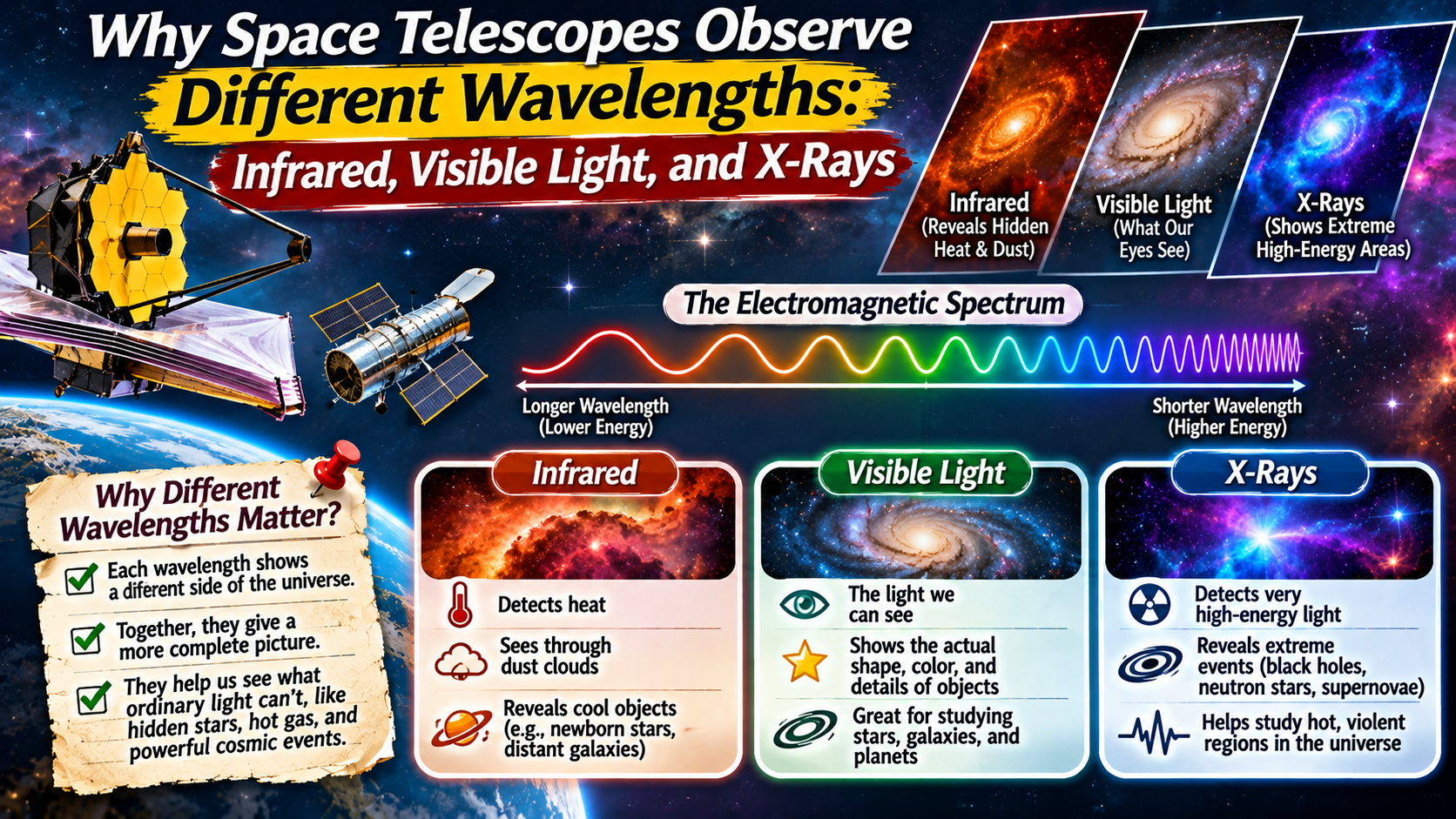
Different wavelengths reveal different physical processes, temperatures, and structures in space.
By combining observations across the electromagnetic spectrum, scientists develop a more complete understanding of the universe.
What Are Electromagnetic Wavelengths?
Light is a form of electromagnetic radiation.
It travels through space as electromagnetic waves and can also be described in terms of particles called photons.
Electromagnetic radiation exists across a broad spectrum.
This includes radio waves, microwaves, infrared radiation, visible light, ultraviolet radiation, X-rays, and gamma rays.
The different categories are distinguished mainly by wavelength and frequency.
Wavelength describes the distance between corresponding points on successive waves.
Frequency describes how many wave cycles pass a point each second.
Shorter wavelengths correspond to higher frequencies and more energetic photons.
Longer wavelengths correspond to lower frequencies and less energetic photons.
Visible light occupies only a small portion of this spectrum.
Human eyes cannot directly detect infrared radiation or X-rays, but specialized scientific instruments can.
ELECTROMAGNETIC SPECTRUM / REFERENCE
Longer wavelengths than visible red light; useful for studying cool objects and dust-obscured regions.
The narrow range detectable by human eyes; useful for studying stars, galaxies, and reflected light.
Much shorter wavelengths and higher photon energies; useful for studying extremely hot gas and energetic cosmic events.
Why Astronomers Need Different Types of Telescopes
Objects in space emit or interact with electromagnetic radiation in different ways.
A relatively cool cloud of dust may emit much of its radiation at infrared wavelengths.
A star like the Sun produces substantial visible light.
Gas heated to millions of degrees can emit strongly in X-rays.
Because these objects have different physical properties, they cannot all be studied effectively using the same wavelength range.
Specialized telescopes help astronomers detect the radiation most relevant to a particular scientific question.
They also use different detector technologies and optical designs.
For example, a visible-light telescope commonly uses mirrors or lenses to focus light.
An X-ray telescope requires a different optical approach because high-energy X-rays do not reflect efficiently from ordinary mirrors at typical angles.
These differences make multiwavelength astronomy an essential part of modern space science.
Infrared Telescopes: Looking Through Cosmic Dust
Infrared radiation has longer wavelengths than visible light.
Infrared observations are especially valuable for studying relatively cool astronomical objects and regions obscured by dust.
Interstellar dust can absorb and scatter visible light, making objects behind dense clouds difficult to observe.
At certain infrared wavelengths, astronomers can see through some dusty regions more effectively.
This allows researchers to investigate developing stars, planetary systems, and distant galaxies.
Infrared telescopes can also detect thermal radiation emitted by relatively cool objects.
Examples include brown dwarfs, some planets, and dust surrounding young stars.
However, infrared light does not pass through every dust cloud equally well.
The amount of penetration depends on wavelength, dust properties, and the density of the material.
Why Infrared Telescopes Need Cooling
Infrared instruments face a special challenge.
Objects at ordinary temperatures emit infrared radiation, including parts of the telescope itself.
This unwanted radiation can interfere with faint astronomical signals.
To reduce interference, infrared telescopes may use passive cooling, sunshields, or active cryogenic systems.
The cooling strategy depends on the wavelengths being observed and the instrument design.
Keeping the equipment sufficiently cold improves sensitivity to faint infrared sources.
INFRARED OBSERVATORY / RESEARCH NOTE
Infrared Telescopes Reveal Regions That Visible-Light Observations May Miss.
They are particularly useful for examining dusty star-forming regions, cool astronomical objects, and light stretched to longer wavelengths by cosmic expansion.
The James Webb Space Telescope and Infrared Astronomy
The James Webb Space Telescope, commonly called JWST, is designed primarily for infrared astronomy.
Its instruments observe near-infrared and mid-infrared wavelengths.
One of its major scientific goals is to study galaxies that formed during the early history of the universe.
As the universe expands, light traveling through space can be stretched toward longer wavelengths.
This process is known as cosmological redshift.
Light that was originally emitted at visible or ultraviolet wavelengths may reach astronomers as infrared radiation.
Infrared observations therefore help scientists investigate extremely distant galaxies.
JWST also studies star formation, planetary systems, and the atmospheres of some exoplanets.
Its large segmented mirror and sensitive instruments allow it to detect faint infrared signals from distant objects.
Visible-Light Telescopes: Studying Stars and Galaxies
Visible-light telescopes collect the portion of electromagnetic radiation detectable by human eyes.
These observations reveal stars, galaxies, nebulae, and many other astronomical objects.
Visible-light images can show the shapes and structures of galaxies.
They also help astronomers examine star clusters and measure changes in stellar brightness.
By separating visible light into different wavelengths, scientists can study an object’s spectrum.
Spectroscopy provides information about chemical composition, motion, and physical conditions.
For example, characteristic absorption or emission lines can reveal the presence of particular elements.
Changes in spectral wavelengths can also help measure motion along the line of sight.
Visible-light astronomy remains fundamental even though many important cosmic processes are best observed at other wavelengths.
The Hubble Space Telescope: More Than Visible Light
The Hubble Space Telescope is widely known for its detailed images of galaxies, nebulae, and other celestial objects.
Although many famous Hubble images use visible-light observations, the telescope also observes portions of the ultraviolet and near-infrared spectrum.
This broader capability allows researchers to study different properties of astronomical objects.
Hubble has contributed to measurements of cosmic expansion, galaxy evolution, stellar populations, and many other topics.
Its position above Earth’s atmosphere provides important observational advantages.
However, space-based telescopes still require careful calibration and sophisticated instruments to produce scientifically useful measurements.
X-Ray Telescopes: Exploring the Universe’s Most Energetic Regions
X-rays have much shorter wavelengths and higher photon energies than visible or infrared light.
They are associated with some of the most energetic environments in the universe.
Extremely hot gas can produce X-ray emission.
Such gas is found in galaxy clusters, supernova remnants, and regions surrounding certain compact objects.
Material falling toward black holes or neutron stars can also become extremely hot and emit X-rays.
By studying these emissions, astronomers investigate processes involving strong gravity, powerful magnetic fields, and high-energy particles.
X-ray astronomy provides information that may be difficult or impossible to obtain from visible-light images alone.
Why X-Ray Telescopes Use Special Mirrors
Ordinary telescope mirrors are not suitable for focusing most astronomical X-rays in the same way they focus visible light.
X-rays tend to penetrate or be absorbed by materials when they strike at larger angles.
Many X-ray telescopes therefore use grazing-incidence optics.
In these designs, X-rays strike specially shaped mirrors at very shallow angles.
This allows the radiation to be redirected toward sensitive detectors.
The engineering requirements differ significantly from those of conventional optical telescopes.
The Chandra X-Ray Observatory
NASA’s Chandra X-ray Observatory was launched in 1999 to study high-energy phenomena in space.
Its observations have contributed to research involving black holes, supernova remnants, galaxy clusters, and other energetic systems.
Chandra uses specialized grazing-incidence mirrors to focus X-rays.
Its high angular resolution has made it particularly valuable for examining fine structures in X-ray-emitting regions.
When Chandra observations are combined with images from optical or infrared telescopes, scientists can investigate how energetic processes relate to surrounding stars, gas, and dust.
Why Space Telescopes Operate Above Earth’s Atmosphere
Earth’s atmosphere affects incoming electromagnetic radiation.
Some wavelengths pass through the atmosphere relatively well.
Visible light reaches the ground across much of its wavelength range, allowing powerful optical observatories to operate on Earth.
Certain infrared wavelengths also reach ground-based instruments, although atmospheric absorption and thermal emission create challenges.
Most astronomical X-rays are absorbed high in Earth’s atmosphere.
That absorption protects life on the surface but makes ground-based X-ray astronomy impractical.
X-ray observatories therefore need to operate above most or all of the atmosphere.
Space-based telescopes also avoid atmospheric turbulence, which can blur visible-light images.
However, ground-based observatories remain extremely important and can offer large collecting areas and instruments that are easier to maintain or upgrade.
Comparing Infrared, Visible-Light, and X-Ray Telescopes
| Feature | Infrared | Visible Light | X-Rays |
|---|---|---|---|
| Relative wavelength | Longer | Intermediate | Much shorter |
| Common targets | Cool objects, dust, distant galaxies | Stars, galaxies, nebulae | Hot gas, black hole environments |
| Important challenge | Thermal background | Atmospheric distortion | Atmospheric absorption and specialized optics |
| Example observatory | James Webb | Hubble | Chandra |
How Multiple Wavelengths Reveal Different Parts of One Galaxy
Imagine astronomers studying a distant galaxy.
A visible-light image might reveal its spiral arms, bright stars, and overall structure.
An infrared observation could reveal dust-obscured regions and help identify areas associated with star formation.
An X-ray image might reveal extremely hot gas, energetic stellar remnants, or activity associated with a central black hole.
Each image provides different information about the same object.
When researchers compare the observations, they can connect processes that would otherwise appear unrelated.
This approach is called multiwavelength astronomy.
It is particularly useful for understanding complex systems such as galaxies, supernova remnants, and star-forming regions.
ONE GALAXY / THREE OBSERVATIONAL WINDOWS
Highlights cooler dust and can reveal structures hidden from visible-light observations.
Shows stars, galaxy structure, and light emitted or reflected at optical wavelengths.
Reveals energetic regions such as hot gas and material near compact objects.
Why Telescope Images Sometimes Use Artificial Colors
Many astronomical images contain colors that have been assigned during scientific image processing.
This is particularly common when the observations involve wavelengths invisible to human eyes.
Infrared and X-ray detectors record measurements rather than ordinary color photographs.
Scientists can assign visible colors to different wavelength bands or intensity ranges.
These color mappings help reveal structures, distinguish emissions, and communicate scientific findings.
The resulting images are not necessarily representations of how an object would appear to human vision.
However, when produced carefully, they remain meaningful visualizations of real observational data.
What Multiwavelength Astronomy Teaches Us About the Universe
Combining observations across the electromagnetic spectrum helps astronomers investigate the full life cycle of stars.
Infrared observations can reveal young stars forming inside dusty clouds.
Visible-light observations show many stars during long periods of their evolution.
X-ray observations reveal high-energy processes associated with stellar remnants and extremely hot environments.
Multiwavelength studies also help researchers investigate galaxy evolution.
They can compare stellar populations, dust, gas, and energetic activity.
Each wavelength adds another piece of information to the scientific picture.
The result is a more detailed understanding of how cosmic structures form, change, and interact.
Frequently Asked Questions
Why do space telescopes observe different wavelengths?
Different wavelengths reveal different temperatures, materials, and physical processes, allowing astronomers to study objects that may be difficult to understand using visible light alone.
What can infrared telescopes see?
Infrared telescopes can study relatively cool objects, dusty star-forming regions, and distant galaxies whose light has been redshifted.
Why is visible-light astronomy still important?
Visible-light observations provide valuable information about stars, galaxies, nebulae, and the structure and composition of astronomical objects.
What do X-ray telescopes detect?
They detect high-energy radiation from environments such as extremely hot gas, supernova remnants, and material near black holes or neutron stars.
Why can’t ordinary X-ray telescopes operate on the ground?
Earth’s atmosphere absorbs most incoming astronomical X-rays before they reach the surface.
Is the James Webb Space Telescope better than Hubble?
They have different observational strengths. Webb specializes in infrared astronomy, while Hubble provides important ultraviolet, visible-light, and near-infrared observations.
Are telescope image colors real?
Some images approximate visible colors, while others use assigned colors to represent wavelengths or intensities that human eyes cannot directly detect.
Final Thoughts
The universe emits far more than the visible light detected by human eyes.
Infrared telescopes reveal cool objects, dusty regions, and light stretched by cosmic expansion.
Visible-light telescopes help astronomers study stars, galaxies, and many familiar celestial structures.
X-ray telescopes uncover extremely energetic environments involving hot gas, compact objects, and powerful cosmic events.
Each wavelength provides a different view of the same universe.
By combining these observations, scientists can investigate astronomical objects more completely and discover relationships that would remain hidden through a single type of telescope.
Modern astronomy therefore depends not on one perfect telescope, but on many specialized observatories working across the electromagnetic spectrum.