🚀 Mars Exploration Analysis: Mars Sample Return (MSR) Mission Architecture
This technical monograph evaluates Mars mission entry physics, robotic mobility mechanisms, paleoclimatological geomorphology, and sample return architectures under the editorial direction of Annamae Turner.
The Ultimate Milestone: Why Mars Sample Return Is Mandatory
For over half a century, robotic Mars missions have gathered increasingly sophisticated in-situ data regarding the Red Planet’s mineralogy, paleoclimate, and potential habitability. Yet, no matter how capable a mobile laboratory like Perseverance is, miniaturized rover instruments operate under severe physical constraints:
– Mass and volume envelopes are restricted by launch vehicle fairings.
– Electrical power is throttled to hundreds of watts by solar panels or MMRTG cores.
– Robotic sensors are vulnerable to calibration drift, radiation noise, and environmental contamination.
In contrast, terrestrial geochronology, geochemistry, and astrobiology laboratories occupy entire buildings, draw megawatts of power, and utilize state-of-the-art analytical equipment:
– **Synchrotron Radiation X-Ray Fluorescence:** Resolves atomic-scale elemental lattices without damaging the sample.
– **Secondary Ion Mass Spectrometry (SIMS) and NanoSIMS:** Measures isotopic ratios across sub-micron mineral grains, establishing absolute radiometric ages with margins under 0.1%.
– **Transmission Electron Microscopy (TEM):** Directly images individual cell wall membranes, fossilized flagella, or microbial organo-mineral crystallization.
– **Replicable Science:** Samples returned to Earth can be distributed to hundreds of independent laboratories worldwide and curated for decades, allowing future generations of scientists to re-analyze the material using analytical techniques that have not yet been invented (precisely as continues to occur with the Apollo lunar samples).
The **Mars Sample Return (MSR)** campaign—a joint multi-spacecraft partnership between NASA and the European Space Agency (ESA)—represents the most complex, multi-vehicle robotic planetary exploration architecture ever conceived in aerospace history.
Perseverance’s Sample Caching System: Hermetic Titanium Tubes and the Three Forks Depot
The first phase of the Mars Sample Return campaign is already actively underway on the surface of Mars. At the core of the Perseverance rover is the **Adaptive Caching System (ACS)**—one of the most complex mechanical mechanisms ever built for a space probe.
The ACS comprises:
– An internal robotic Sample Handling Arm mounted inside the rover belly, surrounded by a rotating carousel holding drill bits and empty sample tubes.
– 43 hermetically sealable sample tubes, precision-machined from ultra-pure aerospace-grade titanium alloy and coated with gold to prevent solar thermal overheating.
– Four procedural blank tubes designed to capture ambient Martian atmospheric vapors and potential rover outgassing contaminants, providing clean analytical baselines for terrestrial laboratories.
When Perseverance encounters a high-priority rock outcrop, the rover’s rotary-percussive coring drill extracts a cylindrical rock core measuring 13 millimeters in diameter and 60 millimeters in length. The tube is retracted into the rover’s belly, inspected by internal cameras, volume-measured, and hermetically sealed using an automated cold-welding metal seal that preserves volatile gases at extraterrestrial vacuum pressures.
To ensure sample retrieval survivability against potential rover mechanical breakdown, Perseverance executed the **Three Forks Sample Depot** campaign between December 2022 and January 2023. The rover dropped a backup cache of ten hermetically sealed sample tubes onto the flat ground of Jezero Crater’s Three Forks region. Each tube was photographed and geo-referenced with millimeter accuracy, ensuring that even if Perseverance suffers a catastrophic failure, a recovery vehicle can collect the dropped cache.
| MSR Architecture Element | Managing Organization | Operational Environment | Primary Mission Hardware | Key Aerospace First |
|---|---|---|---|---|
| Sample Caching Rover | NASA / JPL | Jezero Crater Surface | Perseverance Robotic Arm & ACS | Hermetic titanium sample tube caching |
| Sample Retrieval Lander | NASA / MSFC & JPL | Surface Landing Zone | 2.3-ton Retro-Propulsion Lander | Heaviest planetary surface landing vehicle |
| Mars Ascent Vehicle (MAV) | Lockheed Martin / MSFC | Surface to Low Mars Orbit | 2-Stage Solid Rocket (Cryo-propellant) | First rocket launch from extraterrestrial surface |
| Earth Return Orbiter (ERO) | European Space Agency (ESA) | Mars Orbit to Earth Transfer | High-Power Solar Electric Propulsion | Autonomous deep-space optical rendezvous & capture |
| Earth Entry Vehicle (EEV) | NASA / Langley & Ames | Interplanetary Direct Re-entry | Parachute-Less Passive Crush Capsule | Direct 12 km/s impact with BSL-4 biocontainment |
The Sample Retrieval Lander (SRL) and Mars Ascent Vehicle (MAV)
The second phase of the MSR architecture centers upon the **Sample Retrieval Lander (SRL)**, managed by NASA’s Marshall Space Flight Center and JPL. Massing over 2.3 metric tons upon atmospheric entry, the SRL will be the heaviest spacecraft ever landed on the surface of Mars, requiring upgraded supersonic parachutes and a high-thrust terminal retro-propulsion system.
Once safely on the surface of Jezero Crater, the SRL executes two primary retrieval functions:
1. **Sample Transfer:** If Perseverance remains operational, the rover will drive directly to the lander and use its robotic arm to transfer its internal primary collection of titanium sample tubes into the lander. In the contingency scenario where Perseverance is disabled, the lander deploys two **Sample Recovery Helicopters** (upgraded developments of the historic Ingenuity helicopter, equipped with wheeled landing gear and lightweight mechanical gripper arms) to fly out to the Three Forks depot, pick up the dropped tubes, and fly them back to the lander.
2. **Loading the Orbiting Sample Container:** An ESA-built Sample Transfer Arm (STA)—a 2-meter robotic manipulator—transfers up to 30 sample tubes into a soccer-ball-sized containment vessel known as the **Orbiting Sample (OS) Container**, mounted inside the nosecone of the Mars Ascent Vehicle.
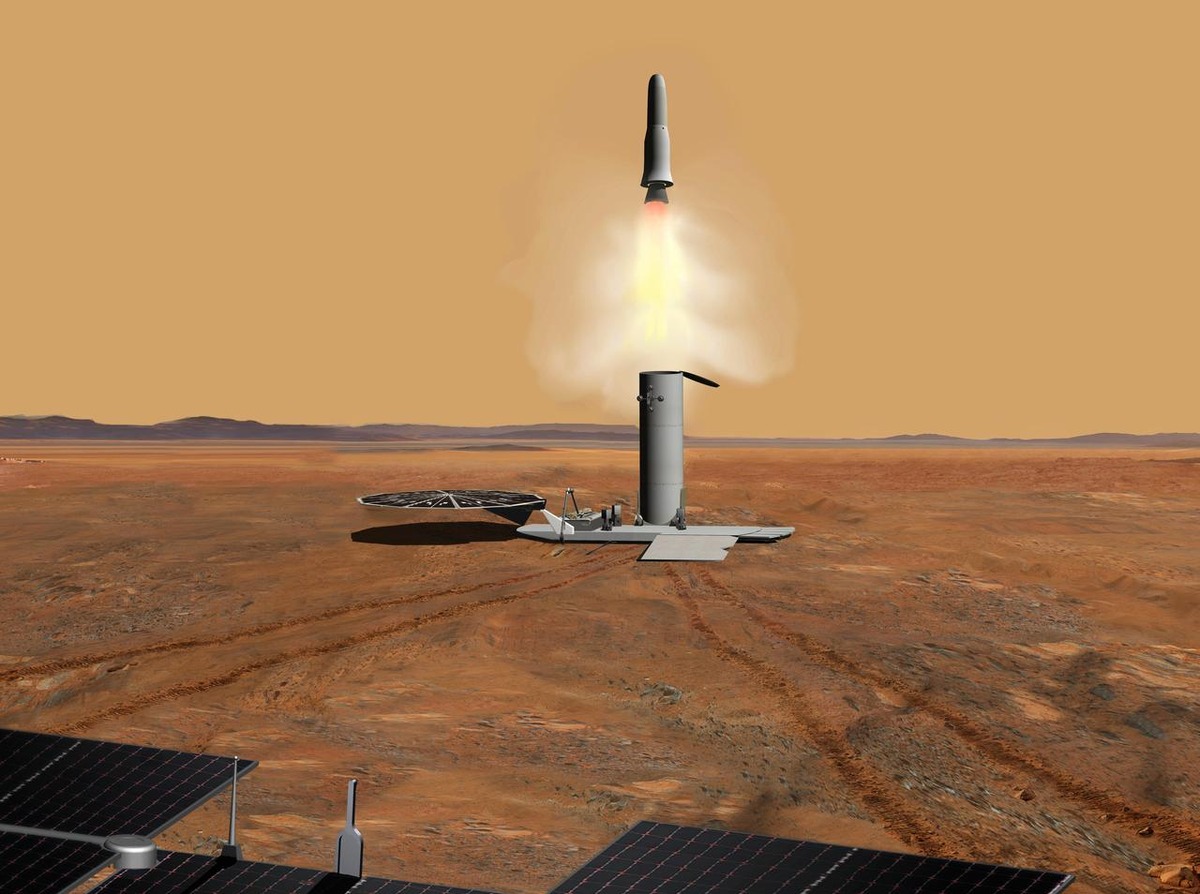
The **Mars Ascent Vehicle (MAV)** will make history as the **first rocket ever to launch from the surface of another planet**:
– Engineered by Lockheed Martin and NASA MSFC, the MAV is a two-stage solid-propellant rocket measuring 3.0 meters in length and massing approximately 450 kilograms.
– Because solid propellants can crack or degrade when exposed to the extreme -100°C Martian diurnal thermal cycles, the MAV utilizes a newly formulated low-temperature solid propellant chemistry that remains flexible and ignition-ready at cryogenic temperatures.
– Launching from the lander deck using an innovative ‘pneumatic toss’ mechanism (vertically ejecting the rocket into the air before main engine ignition to protect the lander deck), the MAV accelerates through the thin Martian atmosphere, shedding its first stage and igniting its spin-stabilized second stage to place the OS canister into a stable 500-kilometer circular orbit around Mars.
The Earth Return Orbiter (ERO) and Autonomous In-Orbit Capture
While the MAV ascends from the surface, the third phase of the campaign is executed by the **Earth Return Orbiter (ERO)**, built by the European Space Agency (ESA) with Airbus as the prime industrial contractor.
Massing 6.5 metric tons at launch, ERO is a massive orbital spacecraft powered by high-efficiency solar arrays spanning 40 meters across and utilizing high-power **Solar Electric Propulsion (SEP)** Hall-effect thrusters. After executing an interplanetary cruise and entering Mars orbit, ERO utilizes the NASA-developed **Capture, Containment, and Return System (CCRS)** to accomplish the autonomous orbital capture:
1. **Optical Detection & Tracking:** The OS canister floats passively in Mars orbit without an active radio transponder. ERO utilizes narrow-angle optical tracking cameras and laser rangefinders (LIDAR) to detect the tiny 20-centimeter canister against the dark background of deep space from hundreds of kilometers away.
2. **Autonomous Orbital Rendezvous:** ERO maneuvers autonomously to match orbital velocity with the canister, capturing it inside an articulated capture cone mechanism.
3. **Biological Sterilization & Sealing:** In accordance with international planetary protection treaties (COSPAR Category V, Restricted Earth Return), the exterior of the sample container must be treated as potentially biologically hazardous. Inside the CCRS, the canister is enclosed within multiple nested containment vessels and sealed using robotic high-temperature brazing torches. This thermal seam-welding process completely incinerates any microscopic Martian dust particles clinging to the exterior joint, creating an impenetrable biological barrier that prevents unsterilized extraterrestrial contact with Earth’s biosphere.
Planetary Protection, Earth Entry, and Curation in Biohazard Containment
With the sealed sample container secured inside the **Earth Entry Vehicle (EEV)**—a blunt-body ablative re-entry capsule mounted atop ERO—the orbiter fires its ion thrusters to escape Martian gravity, executing an interplanetary return cruise toward Earth.
Upon approaching Earth, ERO does not enter orbit; instead, it establishes a targeted hyperbolic trajectory, releases the passive Earth Entry Vehicle, and executes a divert burn that sends the mother spacecraft safely into a permanent heliocentric graveyard orbit, ensuring that the main spacecraft cannot accidentally impact Earth.
The Earth Entry Vehicle re-enters Earth’s atmosphere at extreme hypersonic velocity (over 12,000 meters per second, or Mach 35). To eliminate single-point mechanical failure modes (such as parachute deployment mortar failure or bridle tangle), the EEV is engineered as a **Parachute-Less Passive Impact Capsule**:
– The capsule’s aerodynamic outer shell is fabricated from carbon-carbon and high-density PICA heat shield materials that dissipate extreme re-entry heating.
– The internal structure houses a crushable carbon-composite and cellular aluminum shock-absorption matrix.
– The capsule strikes the soft clay flats of the Utah Test and Training Range (UTTR) at a terminal velocity of 40 meters per second (145 km/h). The crushable matrix absorbs the kinetic energy of touchdown, preserving the structural integrity of the titanium sample tubes and the pristine mineralogical stratigraphy within.
Following recovery by hazardous materials retrieval teams, the capsule will be transported directly into a newly constructed, state-of-the-art **Mars Sample Receiving Facility (MSRF)**. Operating under Biosafety Level 4 (BSL-4) negative-pressure containment and pristine positive-pressure ultra-cleanroom conditions, scientists will extract the rock cores, initiating the definitive empirical investigation into the geological evolution, climate history, and paleobiological potential of Mars.
Geochronology and the Calibration of Inner Solar System Cratering Chronology
Beyond the profound search for ancient Martian life, Mars Sample Return will revolutionize planetary geochronology across the entire solar system. Currently, all absolute ages assigned to surfaces across Mars, Mercury, and the asteroids are extrapolated from the Apollo lunar crater-counting timeline.
Because Mars is located in immediate orbital proximity to the Main Asteroid Belt, its asteroid impact flux is fundamentally different from the Earth-Moon system. By obtaining pristine igneous basalts from Jezero Crater’s floor and crater rim:
– Terrestrial geochronologists will perform ultra-precise radiometric isotope dating (Uranium-Lead, Rubidium-Strontium, Potassium-Argon, and Samarium-Neodymium decay chains).
– Pinpointing the exact crystallization age of Jezero’s basalts will anchor the Martian crater chronology curve with absolute empirical calibration for the first time.
– This will decisively resolve whether the Martian Noachian-Hesperian transition occurred at 3.7 billion years or hundreds of millions of years earlier, fundamentally altering our understanding of when rocky planets lose their magnetic fields and atmospheric habitability.
Ultra-Clean Astrobiology Protocols and Curation in the Mars Sample Receiving Facility
When the Earth Entry Vehicle touches down with its sealed titanium tubes, it will be moved directly into the Mars Sample Receiving Facility (MSRF). The architectural and biocontainment requirements of this facility are unprecedented, combining two diametrically opposed containment standards within a single unified facility:
1. **Biohazard Negative-Pressure Containment (BSL-4):** Under international planetary protection covenants, the facility must ensure zero leakage of putative Martian microorganisms or biohazards into the terrestrial biosphere. Air handling systems utilize cascading negative pressure zones and multi-stage HEPA filtration alongside thermal incineration exhaust systems.
2. **Ultra-Clean Positive-Pressure Isolation:** Simultaneously, the samples must be protected from terrestrial biological and chemical contamination. If a single terrestrial skin flake, microbe, or aerosol hydrocarbon contacts a Martian rock core, it could produce false-positive biosignature readings that corrupt the scientific validity of the entire multi-billion-dollar mission.
To satisfy these contradictory demands, robotic manipulators and sample extraction gloveboxes are sealed within hermetic isolation chambers purged with ultra-pure gaseous nitrogen. Scientists will utilize non-destructive analytical techniques—including micro-computed tomography (micro-CT) scanning, synchrotron radiation X-ray fluorescence, and multi-spectral microscopic imaging—while the sample tubes remain sealed under extraterrestrial vacuum or dry nitrogen atmospheres.
Only after exhaustive non-destructive physical screening will individual core slices be partitioned and distributed to specialized consortium laboratories worldwide, initiating the golden age of empirical Martian astrobiology.
Technological Spin-offs and the Foundation for Human Mars Landings
The engineering architectures pioneered for Mars Sample Return represent the direct technical stepping stones required to land humans on the Red Planet:
1. **Autonomous Extraterrestrial Launch:** Demonstrating that a rocket can be landed, kept cold for a Martian winter, erected, fueled, and launched autonomously into orbit verifies the core operational cycle required for the crewed Mars Ascent Vehicle (MAV).
2. **Deep-Space Bio-Containment:** The hermetic sealing, thermal seam-brazing, and pristine sample handling protocols developed for MSR will protect Earth from extraterrestrial forward and backward contamination, establishing the regulatory framework for human crew return.
3. **Heavy Planetary EDL:** The 2.3-ton Sample Retrieval Lander advances heavy-mass supersonic retro-propulsion, terminal terrain-relative guidance, and high-energy thermal protection systems.
Through MSR, robotics and human exploration converge, transforming the Red Planet from an inaccessible telescopic curiosity into an interconnected scientific province of humanity.