🚀 Space Astronomy Deep-Dive: The James Webb Space Telescope (JWST)
This technical monograph evaluates space-based astronomical observatories, optical design physics, cryogenic infrared instrumentation, and exoplanetary spectroscopy under the editorial leadership of Annamae Turner.
The Infrared Imperative: Why JWST Had to See in the Infrared
While the Hubble Space Telescope revolutionized optical astronomy, it encountered an insurmountable cosmological horizon. Because the universe has been expanding for 13.8 billion years, light emitted by the very first stars and galaxies (Population III stars and early protogalaxies) has been traveling across expanding space-time.
As photons traverse cosmological distances, their wavelengths are stretched by the cosmic scale factor in accordance with cosmological redshift:
\[ 1 + z = \frac{\lambda_{observed}}{\lambda_{emitted}} \]
Light emitted in the ultraviolet and visible spectrum by primordial stars at redshifts $z > 10$ has been stretched by more than a factor of ten, shifting completely out of the visible spectrum and into the **near- and mid-infrared wavelengths** ($1.0\,\mu\text{m}$ to $28\,\mu\text{m}$).
Furthermore, infrared light possesses the extraordinary capability to penetrate dense cosmic dust clouds. In visible light, interstellar dust grains (measuring roughly 0.1 to 1.0 micrometers) scatter optical photons, creating opaque dark nebulae that completely conceal star-forming regions. Because infrared wavelengths are significantly larger than the dust grain diameters, infrared photons glide past dust particles unimpeded, revealing embryonic protostars, protoplanetary disks, and active galactic nuclei buried deep within cosmic cocoons.
To pierce this cosmic veil, NASA, in international partnership with ESA and the Canadian Space Agency (CSA), engineered the **James Webb Space Telescope (JWST)**—the largest, most complex, and most audacious space science observatory ever launched.
Beryllium Hexagonal Mirror Segments and Gold Vapor Deposition
To gather the faint, ancient infrared photons emitted over 13.5 billion years ago, JWST required an enormous light-collecting aperture: a primary mirror measuring **6.5 meters in diameter**, possessing an area of 25.4 square meters—nearly six times the collecting area of Hubble.
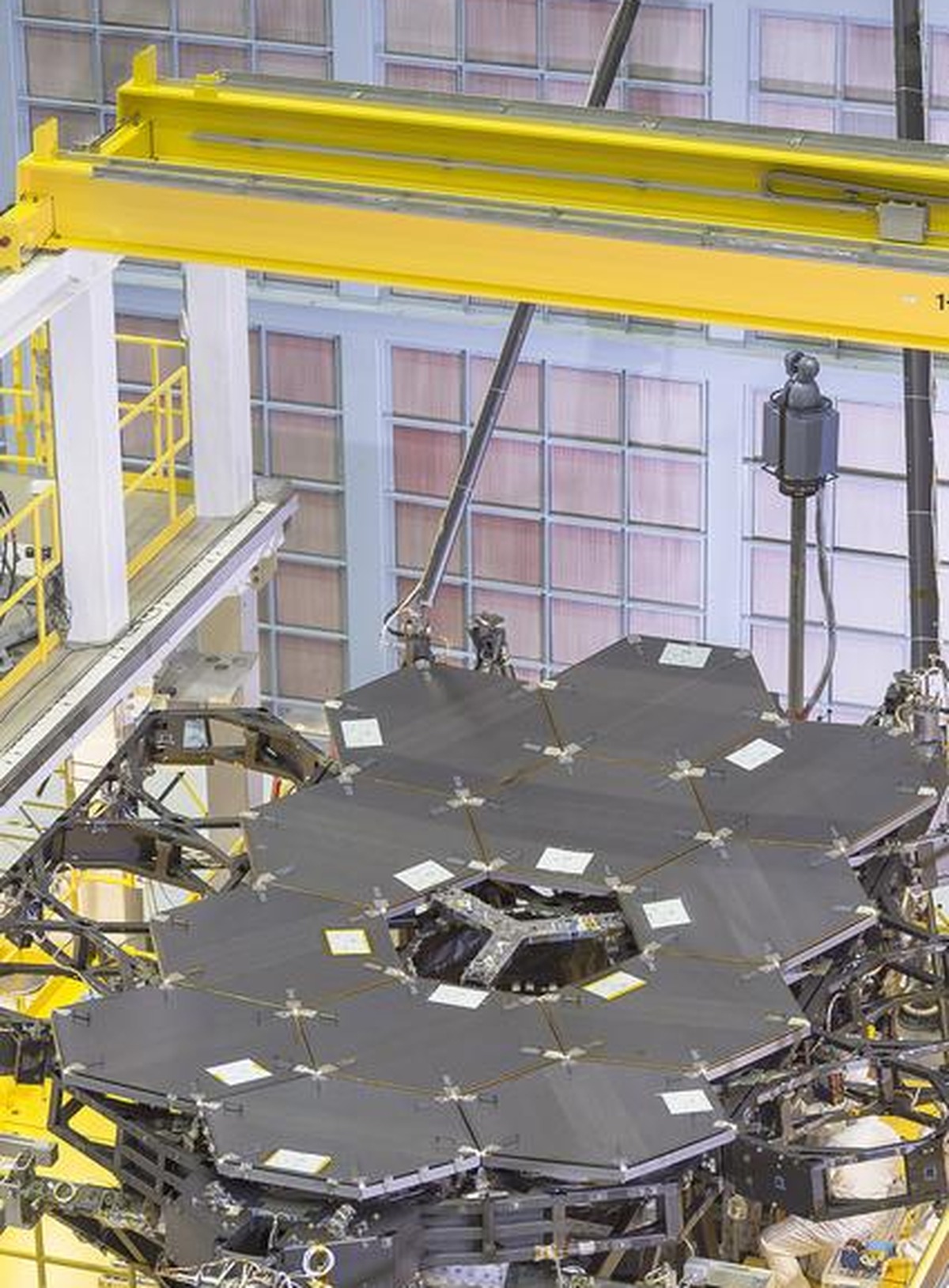
No existing rocket fairing could accommodate a rigid 6.5-meter circular mirror. Therefore, NASA opted for a segmented, folding primary mirror comprising **18 hexagonal segments**, arranged in two folding ‘wings’ that deployed following launch.
The engineering of these mirror segments represented a breakthrough in materials science and cryogenic optics:
– **Material Selection (Beryllium):** Glass is too heavy and deforms unpredictably at cryogenic temperatures. Engineers selected **O-30 grade spherical powder beryllium**. Beryllium is exceptionally lightweight yet boasts an extraordinary strength-to-weight ratio and a low coefficient of thermal expansion at cryogenic temperatures near absolute zero.
– **Manufacturing & Machining:** Each 1.32-meter hexagonal segment was pressed under hot isostatic pressing, machined into a delicate honeycomb backing structure that shaved 92% of the metal away, leaving an ultra-lightweight shell weighing merely 20 kilograms (plus 20 kg for actuators and mounts).
– **Gold Reflective Coating:** Once polished to an optical roughness under 20 nanometers, the mirrors were placed inside a vacuum deposition chamber. A microscopic layer of pure gold—measuring precisely **100 nanometers in thickness** (totaling only 48 grams of gold for the entire 6.5-meter mirror array)—was vapor-deposited onto the surface, topped with a thin glass (SiO2) protective film. Gold was selected because its optical reflectance exceeds 98% across near- and mid-infrared wavelengths (0.8 to 28 micrometers), far outperforming aluminum or silver.
| Instrument Name | Wavelength Coverage | Detector Technology | Operating Temperature | Key Cosmological Specialization |
|---|---|---|---|---|
| NIRCam | 0.6 to 5.0 micrometers | HgCdTe (4 Megapixel) | 37 Kelvin (Passive) | Deep-field primordial galaxy imaging; coronagraphy |
| NIRSpec | 0.6 to 5.3 micrometers | Microshutter Array (250k doors) | 37 Kelvin (Passive) | 100-galaxy multi-object spectroscopy simultaneously |
| MIRI | 4.9 to 28.8 micrometers | Arsenic-Doped Silicon (Si:As) | 6.7 Kelvin (Active Pulse Cooler) | Cold dust penetration, PAHs, protoplanetary disks |
| NIRISS / FGS | 0.6 to 5.0 micrometers | Aperture Masking Interferometry | 37 Kelvin (Passive) | Exoplanet transit spectroscopy; 7-milliarcsec guidance |
Nanometer Segment Actuation and Wavefront Sensing
When JWST unfolded its mirror wings in deep space, the 18 segments did not form a single optical surface; they were 18 independent, misaligned mirrors producing 18 separate blurry images of a target star. To act as a single, coherent 6.5-meter diffraction-limited mirror, the segments had to be aligned to within **a fraction of a wavelength of light—an accuracy of under 50 nanometers**.
Mounted behind each mirror segment are **seven micro-positioning mechanical actuators**:
– Six actuators arranged in a hexapod (Stewart platform) to control six degrees of spatial freedom: position along X, Y, Z axes, and rotation around pitch, roll, and yaw.
– A seventh central actuator connected to six struts that mechanically bends the mirror segment, adjusting its radius of curvature.
These actuators utilize extreme precision stepper motors capable of moving in discrete step increments of **7.7 nanometers** (thousands of times thinner than a single strand of DNA).
Using an iterative optical alignment technique known as **Wavefront Sensing and Control**:
1. The Near-Infrared Camera (NIRCam) snaps defocused images of a bright guide star.
2. Wavefront algorithms analyze the optical interference phase patterns, calculating the exact spatial error vector of each segment.
3. The computer pulses the actuators, marching the 18 segments through image identification, segment search, coarse phasing, fine phasing, and multi-field alignment until all 18 segments constructively interfere into a single, razor-sharp point-spread function (PSF).
The Five-Layer Tennis-Court-Sized Cryogenic Sunshield
Infrared telescopes face a ruthless thermodynamic enemy: **heat**. Every physical object with a temperature above absolute zero emits blackbody infrared radiation. If the telescope mirrors, structure, or scientific instruments were at room temperature (+20°C / 293 K), the telescope itself would glow brilliantly in the infrared, blinding its own detectors like an observer trying to see stars while shining a high-powered floodlight directly into a camera lens.
To observe faint cosmic infrared signals, the entire telescope optics and instrument suite must be passively cooled to cryogenic temperatures below **-233°C (40 Kelvin)**.
To achieve this, JWST relies on an astonishing deployable mechanism: a **Five-Layer Cryogenic Sunshield** measuring 21.2 meters long by 14.2 meters wide—the size of a regulation tennis court.
The sunshield is constructed from five ultrathin membranes of **Kapton E polyimide film**:
– The sun-facing Layer 1 is only 0.050 mm (50 micrometers) thick, coated with 100 nm of vapor-deposited aluminum and a 50 nm silicon coating to reflect ultraviolet radiation.
– Layers 2 through 5 are merely 0.025 mm (25 micrometers) thick, coated with aluminum.
– The five layers do not touch; they are separated by precise vacuum gaps held by perimeter spreader booms.
The thermodynamic performance of the sunshield is breathtaking:
– The sunward side faces direct solar radiation, absorbing heat and baking at temperatures up to **+85°C (358 Kelvin)**.
– Each successive layer reflects heat out the sides into the cold vacuum of space.
– By the time thermal energy reaches Layer 5, temperature drops by over 300°C down to **-233°C (40 Kelvin)** on the cold observatory side—an optical thermal attenuation factor exceeding 1,000,000 to 1, achieved entirely without consuming electrical power.
Lagrange Point L2 Orbit Mechanics: Halo Dynamics and Thermal Stability
Hubble orbits in Low Earth Orbit at 540 kilometers altitude, circling the globe every 96 minutes. In LEO, Hubble passes in and out of Earth’s shadow, experiencing violent thermal shocks and having its view occluded by the giant sphere of the warm Earth every orbital cycle.
For JWST, Low Earth Orbit was completely out of the question. To maintain continuous passive cryogenic cooling, the sunshield must point continuously toward the Sun, Earth, and Moon simultaneously.
JWST was therefore injected into an orbit around the **Second Sun-Earth Lagrange Point (L2)**, located **1.5 million kilometers directly behind Earth** along the Sun-Earth axis.
At L2, the combined gravitational forces of the Sun and Earth balance the centrifugal force of an orbiting object, allowing it to orbit the Sun in synchrony with Earth over a 365-day period. However, JWST does not sit motionless at the exact L2 mathematical point (which is gravitationally unstable). Instead, it flies along a giant, looping **Halo Orbit**:
– The halo orbit carries the spacecraft above and below the ecliptic plane across a period of six months, looping around L2 with an orbital radius of approximately 800,000 kilometers.
– This ensures that JWST never passes into the shadows of Earth or the Moon, preserving uninterrupted solar illumination for its photovoltaic power array and continuous line-of-sight to the Deep Space Network on Earth.
– Most critically, from L2, the Sun, Earth, and Moon are perpetually located in the exact same direction in the sky, allowing the five-layer sunshield to act as an unmoving protective umbrella that shields the cryogenic telescope from all three major thermal bodies simultaneously.
The Scientific Instrument Suite and MIRI’s Cryocooler
Nestled inside the Integrated Science Instrument Module (ISIM) behind the primary mirror are four revolutionary scientific instruments:
1. **NIRCam (Near-Infrared Camera):** JWST’s primary imager (0.6 to 5.0 micrometers), equipped with high-density mercury-cadmium-telluride (HgCdTe) astronomical detector arrays and optical coronagraph masks to image exoplanets.
2. **NIRSpec (Near-Infrared Spectrograph):** A multi-object spectrograph capable of observing 100 individual galaxies simultaneously across a single field of view using an innovative **Microshutter Array**—a grid of 250,000 tiny micro-mechanical doors that open and close to let light through from selected galaxies while blocking background sky noise.
3. **NIRISS / FGS (Fine Guidance Sensor & Near-Infrared Imager):** Provides ultra-precise pointing guidance and specialized aperture-masking interferometry for resolving binary stars and close-in exoplanets.
4. **MIRI (Mid-Infrared Instrument):** JWST’s mid-infrared sensor (4.9 to 28.8 micrometers), built by a European consortium and JPL.
While the other three instruments operate happily at passive sunshield temperatures (40 Kelvin), MIRI observes longer mid-infrared wavelengths and requires an even colder environment: its arsenic-doped silicon (Si:As) detectors must be chilled to an astonishing **6.7 Kelvin (-266.5°C)—just seven degrees above absolute zero**.
To achieve this, MIRI incorporates a closed-cycle **Helium Pulse Tube Cryocooler**:
– Helium gas is cyclically compressed by counter-opposed pistons and pulsed through a Joule-Thomson expansion valve.
– As the helium gas expands, it absorbs thermal energy from the MIRI cold head and pumps it across 10 meters of stainless steel tubing to the warm spacecraft side of the sunshield, where the heat is radiated harmlessly into space, keeping MIRI cold without consuming expendable liquid cryogen boil-off.
Cryogenic Metrology, Testing in Chamber A, and Launch Vibrations
Before JWST was folded into the Ariane 5 rocket fairing in French Guiana, the entire telescope underwent the most rigorous cryogenic optical test program ever conceived at NASA’s Johnson Space Center in Houston, Texas.
The telescope was sealed inside **Chamber A**—the historic Apollo thermal-vacuum chamber:
– Chamber A was evacuated to high vacuum ($10^{-5} ext{ Pa}$) and chilled using liquid nitrogen and gaseous helium shrouds down to 20 Kelvin (-253°C) for over 100 consecutive days.
– Engineers fired laser interferometers from the ceiling of the chamber through thermal windows, measuring the nano-scale contraction and optical curvature of all 18 beryllium mirror segments under deep space cryogenic thermal gradients.
– This vacuum testing confirmed that the segments would accurately deform into their designed mathematical parabolas only after reaching their frigid operational temperature at L2.
Furthermore, because JWST possesses over 300 Single-Point Failures (SPFs) across its mechanical deployment sequence (including 178 non-explosive release actuators, 107 sunshield pins, and miles of deployment cables), the spacecraft was subjected to brutal acoustic noise testing simulating the roar of launch (exceeding 140 decibels) and violent vibration sweeps to ensure that no latch, cable, or spring would jam in the microgravity environment of deep space.
Epochal Discoveries: High-Redshift Galaxies and Atmospheric Biosignatures
Since beginning scientific operations in July 2022, JWST has dismantled several long-standing paradigms in observational astrophysics:
– **The ‘Impossible’ Early Galaxies:** JWST discovered a population of massive, luminous galaxies (such as JADES-GS-z14-0) shining brilliantly at redshifts $z = 14.32$—existing a mere 290 million years after the Big Bang. These galaxies were far more massive, chemically enriched with oxygen, and dynamically mature than standard cosmological models predicted, forcing cosmologists to reconsider the speed and efficiency of early cosmic structure formation and supermassive black hole seeding.
– **Exoplanet Atmospheric Chemistry:** JWST performed the first definitive chemical characterization of exoplanet atmospheres, detecting carbon dioxide (CO2), sulfur dioxide (SO2), methane (CH4), and water vapor (H2O) in the atmospheres of hot gas giants and mini-Neptunes (such as WASP-39b and K2-18b).
– **Protoplanetary Disk Chemistry:** Imaging protoplanetary disks around young stars, JWST resolved carbon-bearing molecules and water vapor within the inner terrestrial planet-forming zones, confirming that the basic chemical building blocks for oceans and organic life are ubiquitous throughout the cosmos.