🚀 Robotic Spacecraft Engineering: Cassini-Huygens Exploration of the Saturnian System
This technical monograph provides in-depth documentation covering deep-space probe architecture, autonomous telemetry, nuclear/electric propulsion physics, and planetary science under the editorial direction of Annamae Turner.
The Architecture of a Flagship: The Cassini-Huygens Mission
Launched on October 15, 1997, aboard a Titan IV-B Centaur rocket from Cape Canaveral, the **Cassini-Huygens mission** represented the most sophisticated, heavily instrumented planetary exploration flagship ever constructed. A joint collaboration between NASA, the European Space Agency (ESA), and the Italian Space Agency (ASI), the combined spacecraft massed 5,712 kilograms at launch, of which more than 3,100 kilograms was propellant.
The mission architecture was bipartite:
1. **The Cassini Orbiter:** A four-ton orbital laboratory equipped with twelve sophisticated scientific instruments, powered by three Radioisotope Thermoelectric Generators (RTGs) containing 32.7 kilograms of Plutonium-238.
2. **The Huygens Probe:** A 318-kilogram atmospheric entry probe built by ESA, designed to detach from Cassini, plunge into the dense nitrogen atmosphere of Saturn’s giant moon Titan, and execute humanity’s first soft landing on a world in the outer solar system.
To reach Saturn across 1.4 billion kilometers, Cassini executed a complex **VVEJGA (Venus-Venus-Earth-Jupiter Gravity Assist)** interplanetary cruise:
– Flying by Venus twice (April 1998 and June 1999).
– Sweeping past Earth in August 1999 (gaining 5.5 km/s of delta-v).
– Flying past Jupiter in December 2000, where it calibrated its instruments and conducted coordinated magnetospheric studies with the Galileo spacecraft.
On July 1, 2004, Cassini arrived at Saturn. In a harrowing, precision burn, its twin 445-Newton bipropellant main engines fired for 96 minutes—threading the spacecraft directly through the gap between Saturn’s F and G rings—imparting 626 meters per second of negative delta-v to execute Saturn Orbit Insertion (SOI), beginning a thirteen-year orbital odyssey that fundamentally rewrote planetary science.
Huygens Atmospheric Entry and Landing on Titan’s Methane World
On December 25, 2004, Cassini released the European Huygens probe onto a ballistic collision course with Titan—Saturn’s largest moon, which possesses an atmosphere 1.5 times denser than Earth’s, composed of 95% nitrogen and 5% methane.
On January 14, 2005, Huygens struck Titan’s upper atmosphere at an entry speed of 22,000 kilometers per hour (Mach 20):
– Huygens’ front heat shield, fabricated from high-density ‘AQ60’ phenolic-silica ablative tiles, dissipated peak aerothermal heating exceeding 1,800°C.
– Once decelerated to Mach 1.5, a 2.6-meter pilot drogue parachute deployed, extracting the 8.3-meter disk-gap-band main parachute.
– As Huygens drifted down through the freezing orange hydrocarbon haze (-180°C) across a 2.5-hour descent, its **Descent Imager/Spectral Radiometer (DISR)** transmitted panoramic photographs that stunned mission control: complex dendritic river drainage channels, shorelines, and canyon bluffs carved not by water, but by torrential liquid methane and ethane rain.
At 12:43 UTC, Huygens touched down on Titan’s surface at 4.5 meters per second, becoming the **first and only spacecraft to land on a solid surface in the outer solar system**.
Its penetrometer recorded that the ground had the mechanical consistency of wet sand or crème brûlée—a frozen crust of water-ice gravel saturated with liquid methane hydrocarbons. Huygens operated on battery power for 72 minutes on the freezing surface before Cassini dipped below the local horizon, transmitting surface temperatures of 93.7 Kelvin (-179.5°C) and establishing Titan as a prebiotic cryogenic laboratory mirroring primordial Earth prior to the emergence of life.
| Mission Phase | Key Operational Event | Scientific Instrumentation | Major Astrophysical Discovery |
|---|---|---|---|
| Saturn Orbit Insertion | July 1, 2004 (445 N burn) | Bipropellant Main Engine | First spacecraft to orbit Saturn; threaded ring gap |
| Huygens Probe Descent | January 14, 2005 | DISR & Gas Chromatograph | First landing on outer solar system moon (Titan) |
| Enceladus Flybys | 2005 – 2015 (Tiger Stripes) | INMS & Cosmic Dust Analyzer | Discovered active cryovolcanic plumes & H2 vents |
| Titan Radar Surveys | 127 Targeted Flybys | Ku-Band Synthetic Aperture Radar | Mapped liquid methane seas (Kraken Mare) & dunes |
| Grand Finale | Sept 15, 2017 (22 Dives) | Direct In-Situ Atmospheric Mass Spec | Controlled atmospheric entry disposal protecting moons |
Enceladus Cryovolcanism: Hydrothermal Vents in a Subsurface Ocean
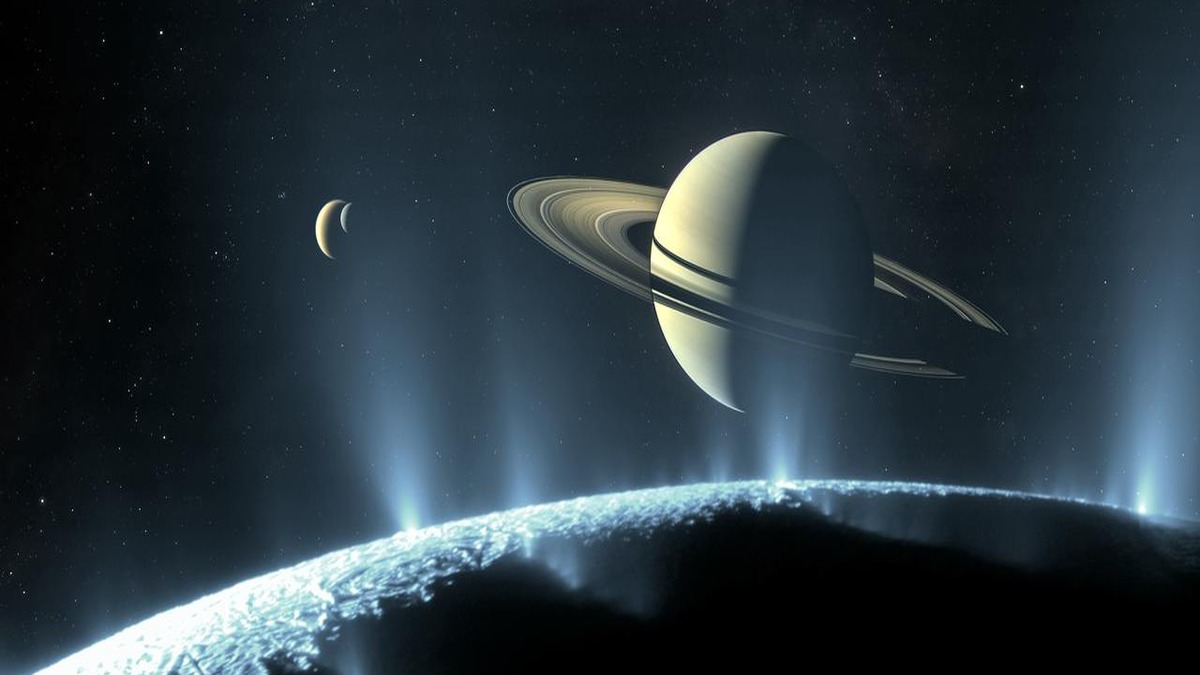
Before Cassini, Saturn’s tiny 500-kilometer-wide moon **Enceladus** was assumed to be a frozen, geologically dead snowball of pure water ice. In early 2005, Cassini’s magnetometer detected localized distortions in Saturn’s magnetic field lines near Enceladus’s south pole, indicating an active source of ionized atmospheric gas.
Cassini pivoted its cameras and executed a sequence of daring low-altitude flybys, swooping within 25 kilometers of the surface. What it discovered was epochal:
– The south polar terrain was gouged by four warm, parallel tectonic fractures nicknamed the **’Tiger Stripes’ (Alexandria, Cairo, Baghdad, and Damascus Sulci)**.
– Erupting from these fractures were over 100 supersonic **Cryovolcanic Geysers**, blasting plumes of water vapor, ice crystals, and volatile gases hundreds of kilometers into space at speeds exceeding 400 meters per second.
– Cassini proved that this continuous cryovolcanic plume is the primary geological engine that generates and sustains Saturn’s entire diffuse **E-Ring**.
In 2015, Cassini executed a historic dive straight through the heart of the plume at a velocity of 8.5 km/s, allowing its Ion and Neutral Mass Spectrometer (INMS) and Cosmic Dust Analyzer (CDA) to directly ‘taste’ the interior of an alien ocean:
– The plumes contained 96% water vapor, 2% molecular nitrogen, 1% carbon dioxide, alongside methane, complex macromolecular organic compounds, and sodium chloride salts matching terrestrial ocean salinity.
– Crucially, INMS detected abundant **Molecular Hydrogen (H2)** and nano-silica particles (SiO2). On Earth, molecular hydrogen and nano-silica are produced exclusively when superheated water ($T > 90^\circ\text{C}$) interacts with olivine and pyroxene rocks in **Deep-Sea Hydrothermal Alkaline Vents** (serpentinization).
This confirmed that Enceladus harbors a global liquid water ocean beneath its 20-kilometer ice crust, warmed by tidal core flexing and anchored to a porous rocky core featuring active hydrothermal vents—fulfilling every fundamental criterion required for the sustenance of chemosynthetic microbial life.
Titan’s Methane Hydrological Cycle and Kraken Mare
Over 127 targeted flybys of Titan, Cassini utilized its Ku-band Synthetic Aperture Radar (SAR) and Visual and Infrared Mapping Spectrometer (VIMS) to pierce the opaque orange atmospheric haze, revealing a dynamic planetary surface dominated by an alien hydrological cycle where **methane (CH4) and ethane (C2H6) replace water**:
– At Titan’s surface temperature of 94 Kelvin (-179°C), methane exists precisely at its thermodynamic triple point, allowing it to transition seamlessly between gas, liquid, and solid ice.
– Cassini mapped vast polar seas and lakes: **Kraken Mare** (covering 400,000 square kilometers, larger than the Caspian Sea), **Ligeia Mare**, and **Punga Mare**.
– Radar sounding penetrated to the bottom of Ligeia Mare, measuring liquid depths of 160 meters and confirming that the sea is composed of pristine liquid methane and ethane with minimal suspended sludge.
Cassini documented seasonal convective cloud storms, equatorial torrential downpours that darkened surface albedo, and expansive equatorial sand dune fields (such as Shangri-La) composed of millimeter-sized granules of complex organic photochemical polymers (tholins) sculpted by global wind patterns.
Ring Dynamics: Propeller Moons, Density Waves, and Ephemeral Rings
Saturn’s rings span 282,000 kilometers across, yet possess an average thickness of merely 10 to 30 meters—making them proportionately thinner than a razor blade. Cassini transformed our understanding of ring physics:
– The rings are not continuous solid sheets; they consist of billions of independent water-ice boulders ranging from microscopic dust specks to house-sized icebergs, moving in Keplerian orbits.
– Cassini discovered **Spiral Density Waves** and bending waves excited by gravitational orbital resonances with outer moons (such as Mimas and Janus), which propagate through the ring plane like ripples in a pond.
– Cassini discovered tiny **Embedded Moonlets** (such as Pan and Daphnis), which clear razor-sharp gaps (the Encke Gap and Keeler Gap), driving wave-like ripples along the gap edges that tower 1.5 kilometers above the ring plane.
– By measuring the mass of the rings via gravity science during its final orbits, Cassini proved that the rings are surprisingly low in mass and geologically young—likely formed merely 100 to 200 million years ago (during the age of the dinosaurs) from the tidal disruption of an ancient icy moon.
Radar Bathymetry of Titan’s Hydrocarbon Seas: Sounding Kraken and Ligeia Mare
During its low-altitude orbital sweeps over Titan’s northern polar reaches, Cassini deployed its Ku-band Synthetic Aperture Radar (SAR) in a pioneering **Bistatic and Altimetric Sounding Mode**, firing radio pulses directly into the dark, reflective liquid surfaces of **Ligeia Mare** and **Kraken Mare**.
The radar results provided the first extraterrestrial bathymetric (ocean depth) measurements in human history:
– Because liquid methane and ethane are exceptionally transparent to radio waves at microwave frequencies (possessing a very low loss tangent), the radar beam penetrated straight through the hydrocarbon liquid column, reflected off the seabed, and bounced back to Cassini’s receiver as a secondary echo.
– The time delay between the surface reflection echo and the seafloor echo measured Ligeia Mare’s maximum depth at **160 meters**, while channels in Kraken Mare plunged to depths exceeding **200 meters**.
– The spectral transparency confirmed that the northern seas consist of over 70% pure liquid methane, with dissolved ethane and nitrogen, holding more than forty times the entire petroleum and natural gas reserves of Earth combined within a single extraterrestrial sea.
Saturn’s Polar Hexagon and Atmospheric Jet Stream Dynamics
At Saturn’s north pole, Cassini photographed one of the most mesmerizing fluid dynamic phenomena in the solar system: a colossal, persistent, six-sided polygon storm system known as the **North Polar Hexagon**.
Measuring nearly 30,000 kilometers across—wide enough to fit more than two full Earths side-by-side inside its perimeter—the hexagon was revealed to be a deeply rooted atmospheric jetstream:
– Winds in the hexagonal jet whip horizontally at over 320 kilometers per hour around a central polar cyclone whose eye measures 2,000 kilometers wide (fifty times larger than an average terrestrial hurricane eye).
– Laboratory fluid dynamics experiments at the University of Oxford subsequently reproduced the phenomenon by spinning tanks of liquid with differential radial shear velocities, demonstrating that the hexagon is a **Stationary Rossby Wave** produced by non-linear shear instability between adjacent retrograde and prograde jetstreams.
– Cassini documented the hexagon’s color shifting from deep blue during northern winter to a golden-olive hue as northern spring sunlight catalyzed photochemical smog production, revealing the complex, multi-year seasonal atmospheric chemistry of the gas giant.
Magnetospheric Physics and Saturnian Auroral Kilometric Radiation
Cassini’s Radio and Plasma Wave Science (RPWS) and magnetometer instruments mapped Saturn’s vast magnetosphere—the second largest magnetic structure in the solar system after Jupiter. Unlike Earth, whose magnetic dipole axis is tilted by 11 degrees relative to its rotational axis, Saturn’s magnetic axis is aligned almost perfectly with its rotational axis to within 0.01 degrees, confounding theoretical dynamo models. Cassini recorded Saturnian Auroral Kilometric Radiation (SKR), discovering that the planet’s radio rotation period fluctuates by up to one percent between northern and southern hemispheres, driven by complex seasonal upper-atmospheric wind drag and plasma mass-loading from Enceladus’s cryovolcanic water plumes.
The Grand Finale: Twenty-Two Dives Through the Ring Gap and Controlled Disposal
By 2017, after thirteen years of continuous operations, Cassini was running dangerously low on its bipropellant hydrazine maneuvering fuel. If the spacecraft ran completely out of fuel, NASA would lose attitude control, leaving Cassini as a derelict derelict floating through the Saturnian system.
Under international planetary protection covenants (COSPAR Category IV), leaving a spacecraft unguided presents a non-zero probability that it could eventually crash into Enceladus or Titan. Because Cassini had discovered that both moons possess liquid water oceans with astrobiological potential, allowing terrestrial microbes (which might have survived dormancy on the RTG-heated bus) to contaminate those pristine alien biospheres was scientifically unthinkable.
NASA and ESA therefore designed the breathtaking **Grand Finale**:
– In April 2017, Cassini utilized a final gravitational nudge from Titan to leap out of its conventional equatorial orbit and plunge into twenty-two daring, unprecedented orbits that dived directly through the **2,000-kilometer gap between Saturn’s innermost D-ring and the upper atmospheric cloud tops**.
– Flying through this uncharted vacuum corridor at speeds exceeding 122,000 kilometers per hour, Cassini tasted Saturn’s upper ionosphere, mapped the planet’s internal gravitational multipoles, and measured the planet’s core magnetic dynamo.
On **September 15, 2017**, Cassini made its final, sacrificial dive directly into Saturn’s atmosphere:
– Firing its small RCS thrusters at 100% duty cycle to keep its high-gain antenna locked onto Earth, Cassini streamed real-time atmospheric composition data directly to the Deep Space Network.
– At 1,500 kilometers above the cloud tops, atmospheric friction overpowered the thrusters. The spacecraft began to tumble, broke apart under hypersonic aerodynamic friction, and vaporized into atomic plasma within seconds, becoming an eternal part of the giant planet it had spent thirteen years illuminating.