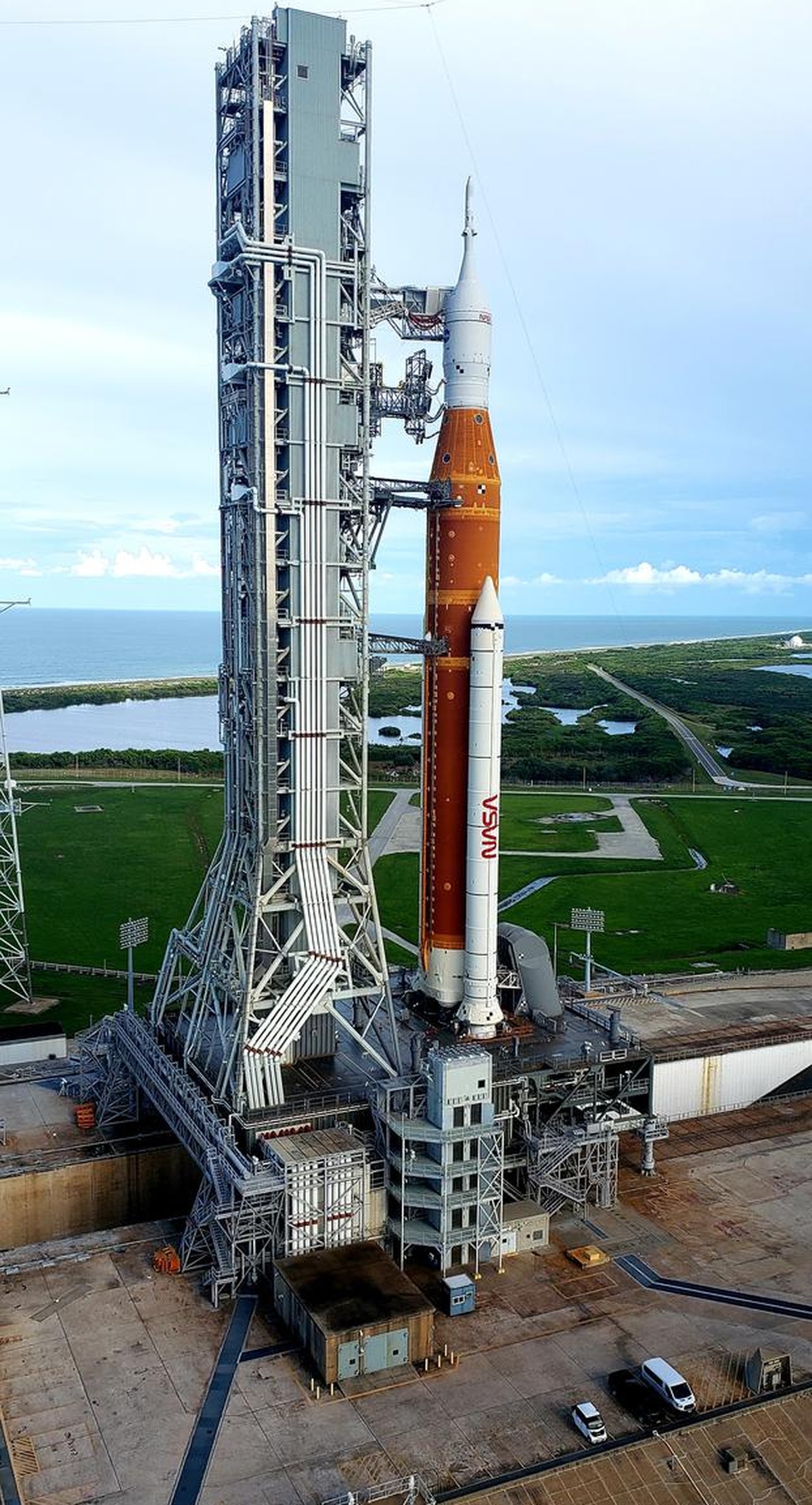
🚀 Orbital Science Overview: Artemis Lunar Architecture
This monograph provides deep technical documentation covering propulsion physics, orbital mechanics, telemetric data, and geochemical planetary science, published under the editorial oversight of Lead Mission Historian Annamae Turner.
The Paradigm Shift from Apollo to Artemis: Deep Space Infrastructure
Five decades following the conclusion of the Apollo program, NASA’s Artemis campaign represents a paradigm shift in human lunar exploration. Where Apollo was an expeditionary cold-war sprint designed to achieve brief reconnaissance sorties to the lunar equatorial mare regions, Artemis is engineered as an infrastructure-heavy, sustainable presence targeting the geologically complex and volatile-rich South Pole of the Moon.
The operational architecture of the Artemis program is structured upon three primary technological pillars:
1. **The Space Launch System (SLS):** A super-heavy expendable launch vehicle capable of delivering the Orion spacecraft, crew, and co-manifested deep-space cargo directly to translunar injection.
2. **The Orion Multi-Purpose Crew Vehicle (MPCV):** A long-duration exploration-class spacecraft featuring an advanced European Service Module (ESM) responsible for primary propulsion, life support consumables, and thermal regulation.
3. **The Lunar Gateway:** An astronaut-tended space station placed into a highly stable, non-Keplerian **Near-Rectilinear Halo Orbit (NRHO)** around the Moon, acting as a deep-space orbital staging node, scientific laboratory, and communications relay between Earth and lunar surface landers.
This distributed architecture provides orbital staging flexibility: instead of carrying the entire lunar lander from Earth on every launch, human landing systems (such as SpaceX’s Starship HLS and Blue Origin’s Blue Moon) are deployed independently to the Moon, refueled in Earth orbit via cryogenic propellant transfer tankers, and dock directly with Orion or Gateway in NRHO. This separates Earth-departure launch loads from planetary landing mass margins, enabling long-duration surface stays and commercial reusable lander lifecycles.
Space Launch System (SLS): Core Stage Propulsion and Solid Rocket Booster Physics
The Space Launch System (SLS) is NASA’s foundational heavy-lift transport system. In its Block 1 configuration (which completed the flawless Artemis I uncrewed shakedown mission in November 2022), the rocket stands 98 meters tall and generates 39.1 meganewtons (8.8 million pounds-force) of thrust at liftoff—surpassing the Saturn V by 15% and producing more liftoff thrust than any human-rated rocket in operational service at the time of its launch.
The SLS propulsion system comprises two distinct propulsion technologies operating in parallel:
– **Dual Five-Segment Solid Rocket Boosters (SRBs):** Manufactured by Northrop Grumman, these are upgraded developments of the Space Shuttle four-segment boosters. Standing 54 meters tall, each booster contains 630,000 kilograms of polybutadiene acrylonitrile (PBAN) solid propellant with an atomized aluminum powder fuel and ammonium perchlorate oxidizer. Burning for 126 seconds, the two boosters supply more than 75% of total liftoff thrust, accelerating the vehicle through Max-Q.
– **The SLS Core Stage:** Measuring 64.6 meters in length and 8.4 meters in diameter, the core stage contains 2 million liters of cryogenic LH2 and LOX maintained at -253°C and -183°C respectively. Propulsion is provided by four Aerojet Rocketdyne RS-25D engines—refurbished Space Shuttle Main Engines (SSMEs) upgraded with new digital engine controller units (ECUs) and operating at 109% rated thrust (producing 2.28 MN of vacuum thrust per engine with a specific impulse of 452 seconds).
Following Core Stage separation at 160 kilometers altitude, the Interim Cryogenic Propulsion Stage (ICPS)—powered by a single RL10B-2 engine burning LH2/LOX with an extendable carbon-composite nozzle yielding a vacuum specific impulse of 462 seconds—performs the critical Perigee Raise Maneuver followed by Translunar Injection (TLI). Future SLS evolutions (Block 1B and Block 2) will replace the ICPS with the Exploration Upper Stage (EUS), powered by four RL10C-3 engines, increasing translunar payload delivery capability from 27 metric tons to over 43 metric tons, enabling the co-manifestation of large Gateway habitat modules alongside the crewed Orion spacecraft.
| Architecture Parameter | Apollo Architecture (1969) | Artemis Architecture (2026+) | Strategic Engineering Advantage |
|---|---|---|---|
| Heavy-Lift Vehicle | Saturn V (Expendable, 3-Stage) | SLS Block 1 / Block 1B | Modern solid booster thrust & composite tanks |
| Mission Staging Node | Direct Lunar Orbit Rendezvous (LOR) | Lunar Gateway (NRHO Halo Orbit) | Continuous Earth communication & reusable staging |
| Primary Crew Spacecraft | Apollo Command/Service Module | Orion MPCV + European Service Module | Quad solar wings, 21-day autonomy, skip re-entry |
| Surface Landing Region | Equatorial Mare Basins | Lunar South Pole (85°-90° S) | Permanently Shadowed Water Ice & Constant Solar Light |
| Mission Objective | Cold-War Reconnaissance Sorties | Sustainable Deep-Space Infrastructure | In-Situ Resource Utilization (ISRU) to Mars |
Orion Crew Module and European Service Module (ESM) Subsystems
The Orion Multi-Purpose Crew Vehicle (MPCV) is designed to sustain a crew of four astronauts on deep-space journeys beyond low-Earth orbit for up to 21 days autonomously, or for extended months when docked to the Lunar Gateway. The spacecraft consists of the aerodynamic Crew Module (CM) and the European Service Module (ESM), developed by Airbus Defence and Space for the European Space Agency (ESA).
The Crew Module features a 5.0-meter diameter blunt-body aerodynamic capsule offering 9 cubic meters of pressurized habitable volume. Its outer surface is shielded by the largest composite heat shield ever built, utilizing Avcoat ablative material—a fiberglass honeycomb matrix filled with epoxy novolac resin. During lunar direct atmospheric entry, Orion encounters Earth’s atmosphere at 11,000 meters per second (Mach 32), generating friction boundary-layer temperatures approaching 2,800°C. Orion utilizes a **Skip Re-entry Trajectory**, dipping into the upper stratosphere to shed speed, skipping back out into high altitude, and re-entering over a designated splashdown corridor, drastically reducing peak deceleration G-loads on the crew from 8G down to 4G.
The European Service Module (ESM) supplies all primary propulsion, attitude control, electrical generation, and life support consumables:
– **Propulsion:** The Orbital Maneuvering System Engine (OMS-E), an Aerojet AJ10 engine derived from the Space Shuttle orbital maneuvering system, provides 26.7 kN of vacuum thrust using storable hypergolic monomethylhydrazine (MMH) and mixed oxides of nitrogen (MON-3). This is supplemented by eight auxiliary thrusters and twenty-four RCS reaction control jets.
– **Power Generation:** Four articulated solar array wings spanning 19 meters across, utilizing high-efficiency triple-junction gallium arsenide (GaAs) photovoltaic cells generating 11.2 kilowatts of electrical power.
– **Environmental Consumables:** Four liquid oxygen and nitrogen tanks provide atmospheric gas replenishment, while water delivery systems supply potable hydration and sublimator cooling loops to dissipate avionics thermal loads.
The Lunar Gateway: Near-Rectilinear Halo Orbit (NRHO) Mechanics
Unlike the International Space Station, which orbits in Low Earth Orbit at 400 kilometers altitude, the Lunar Gateway is deployed in a dynamically unique, non-Keplerian orbit known as a **Near-Rectilinear Halo Orbit (NRHO)**, specifically a Southern L2 Halo orbit.
NRHO belongs to the family of three-body halo orbits originating from the Earth-Moon gravitational Lagrangian points (specifically L2, located beyond the Moon’s far side). In this orbit:
– The Gateway swoops within 3,000 kilometers of the lunar North Pole at perilune, traveling rapidly.
– It climbs to an apolune of 70,000 kilometers over the lunar South Pole, moving slowly along a seven-day orbital period.
– Because the orbital plane is nearly perpendicular to the Earth-Moon line, the station maintains an uninterrupted, continuous direct line-of-sight to Earth tracking stations, eliminating the communications blackout zones that affected the Apollo missions whenever spacecraft passed behind the lunar far side.
Furthermore, NRHO requires virtually zero station-keeping propellant: the gravitational balance between Earth and Moon preserves the orbital orientation, demanding only a minor orbital trim delta-v budget of approximately 10 to 15 meters per second per year. Most importantly, NRHO provides an energetically favorable staging node for surface landing missions: departing NRHO to descend to the lunar South Pole requires only 730 meters per second of delta-v, allowing reusable lunar landers to operate with maximum surface payload fractions.
The initial architecture of Gateway consists of two core elements launched on a commercial Falcon Heavy rocket:
1. **The Power and Propulsion Element (PPE):** Built by Maxar Technologies, the PPE is a high-power 60-kilowatt solar electric propulsion (SEP) spacecraft utilizing advanced Hall-effect thrusters firing Xenon propellant, capable of orbital plane realignment and high-speed laser deep-space optical communications.
2. **The Habitation and Logistics Outpost (HALO):** Built by Northrop Grumman based on the flight-proven Cygnus spacecraft hull, HALO provides pressurized command-and-control quarters, environmental monitoring, scientific experiment racks, and docking ports for Orion, commercial landers, and international logistics resupply vehicles.
Lunar South Pole Target: Permanently Shadowed Regions (PSRs) and In-Situ Resource Utilization (ISRU)
The strategic focal point of the Artemis surface campaign is the Lunar South Pole, specifically crater rims surrounding Shackleton, Faustini, Shoemaker, and Haworth craters. This target was selected due to two extraordinary planetary phenomena discovered by robotic orbital prospectors: **Peaks of Eternal Light** and **Permanently Shadowed Regions (PSRs)**.
Because the Moon’s rotational obliquity is tilted merely 1.54 degrees relative to the ecliptic plane, the Sun skims horizontally across the lunar horizon at the poles. Elevated ridges and crater massifs experience near-continuous solar illumination for up to 90% of the lunar year, providing continuous solar photovoltaic power and benign thermal environments (avoiding the brutal 14-day freezing lunar night characteristic of equatorial Apollo sites).
In stark contrast, deep impact crater floors situated below the local horizon have remained in absolute darkness for over two billion years. Termed Permanently Shadowed Regions (PSRs), these topographic depressions act as cryogenic cold traps where ambient temperatures hover between 25 and 40 Kelvin (-248°C to -233°C)—colder than the surface of Pluto.
Radar data from Chandrayaan-1, NASA’s Lunar Reconnaissance Orbiter (LRO), and the LCROSS impactor confirmed that these cold traps harbor vast deposits of water ice (H2O), carbon dioxide, methane, and ammonia molecules delivered by ancient cometary and asteroid impacts. The presence of accessible water ice is the cornerstone of future deep-space civilization through **In-Situ Resource Utilization (ISRU)**:
– By mining the lunar regolith ice and processing it using thermal sublimators and electrolysis reactors, astronauts can split water molecules into hydrogen and oxygen:
\[ 2H_2O \xrightarrow{Electrolysis} 2H_2 + O_2 \]
– Liquid hydrogen and liquid oxygen constitute the premier high-energy cryogenic propellant chemistry used by modern rocketry. By establishing surface propellent manufacturing plants, the Moon transforms from a desolate destination into an interplanetary refueling depot, slashing Earth-departure launch masses and opening the gateway to human crewed missions to Mars.
Cryogenic Fluid Management (CFM) and Orbital Refueling Architectures
The central technological hurdle separating the Artemis exploration architecture from all preceding lunar programs is **Cryogenic Fluid Management (CFM)** in microgravity. While the Apollo Saturn V launched its entire translunar payload fueled from Earth in a single stack, the scale of Artemis human landing systems—most notably SpaceX’s Starship HLS, massing over 1,200 metric tons fully fueled—demands orbital propellant transfer on an unprecedented industrial scale.
Liquid methane (CH4) and liquid oxygen (LOX) boil at cryogenic temperatures of -161°C and -183°C respectively, while liquid hydrogen (LH2) boils at -253°C. In the radiative vacuum of Low Earth Orbit, solar thermal radiation, Earth albedo infrared heating, and spacecraft engine conduction continuously introduce heat into propellant tanks, inducing rapid boil-off and tank pressure spikes.
To overcome this, Artemis commercial landers are developing active and passive CFM technologies:
– **Multi-Layer Insulation (MLI) and Cryogenic Sunshields:** Vacuum-spaced layers of aluminized mylar and double-gold Kapton that attenuate radiative heat transfer by 99%.
– **Active Cryo-Coolers and Zero-Boil-Off (ZBO) Systems:** Reverse Brayton-cycle mechanical refrigeration units that re-condense vaporized ullage gas back into liquid propellant.
– **Settling Thrusters and Ullage Management:** Because liquids float randomly in microgravity, surface tension screen channels and small continuous acceleration burns are required to seat cryogenic liquids over tank sumps prior to high-volume fluid line transfer.
Deploying a fully fueled Starship HLS to the Moon requires between ten and sixteen orbital refueling tanker launches to fill a dedicated LEO Propellant Depot before the lunar lander departs for cislunar space—establishing an operational logistics chain that will serve as the prototype for future deep-space voyages to Mars.
Autonomous Rendezvous and Docking at the Lunar Gateway in NRHO
Operating within a Near-Rectilinear Halo Orbit requires advanced autonomous guidance and relative navigation (RelNav) architectures. Unlike LEO docking, where Earth’s gravitational gradient dominates, NRHO operates within the complex three-body gravitational field of the Earth, Moon, and Sun, where traditional two-body orbital rendezvous equations (such as the Clohessy-Wiltshire equations) do not apply.
When Orion or a commercial lunar lander approaches the Lunar Gateway in NRHO, navigation transitions through three progressive sensor regimes:
1. **Long-Range Telemetric Approach (100 km to 5 km):** Spacecraft exchange relative position vectors calculated via GPS-derived Earth signals, deep-space optical star-trackers, and Lunar Gateway S-band inter-satellite communication links.
2. **Mid-Range Optical and LIDAR Acquisition (5 km to 500 m):** Flash-LIDAR systems project pulsed laser arrays onto retro-reflector targets mounted on Gateway’s docking ports, measuring range, range-rate, and relative line-of-sight elevation angles at 20 Hz.
3. **Proximity Operations and Contact (500 m to Docking):** High-definition visual cameras and infrared cameras track fiducial markers on the Gateway docking ring. The spacecraft’s autonomous guidance computer commands reaction control thrusters to maintain a docking approach velocity under 0.05 meters per second, aligning with the international standard **International Low Impact Docking System (IDSS)**.
Once mechanical latches lock, automated umbilical connectors mate, establishing high-bandwidth fiber-optic data networks, power sharing, and breathable atmospheric circulation between the spacecraft, completing the deep-space orbital gateway.