🚀 Human Spaceflight Systems: Extravehicular Activity (EVA) Spacesuit Biomechanics
This technical monograph evaluates manned orbital station architecture, life-support chemical engineering, reusable spacecraft aerothermodynamics, spacesuit biomechanics, and space medicine under the editorial leadership of Annamae Turner.
The Spacesuit as an Anthropomorphic Spacecraft: The Lethal Vacuum of Space
Stepping outside a pressurized spacecraft into the vacuum of space is an act that defies terrestrial biology. Without an active life support barrier, the human body encounters an environment of absolute physical hostility:
– **Atmospheric Depressurization & Ebullism:** In the vacuum of space ($P \approx 0\text{ kPa}$), the boiling point of water drops below the standard temperature of human blood (37°C)—a lethal physiological phenomenon known as **Ebullism**. At the Armstrong Limit (19 kilometers altitude, or 6.3 kPa), unpressurized blood, saliva, and ocular fluids boil spontaneously, followed by fulminant hypoxia and loss of consciousness within 12 seconds.
– **Thermal Extremes:** In Low Earth Orbit, unshielded surfaces oscillate violently from **+121°C in direct solar illumination down to -157°C in orbital shadow** every 45 minutes.
– **Micrometeoroids & Orbital Debris (MMOD):** Hypervelocity dust particles striking at velocities up to 10 to 15 kilometers per second possess kinetic energy equivalent to rifle bullets.
– **Solar Ultraviolet & Cosmic Radiation:** High-energy UV radiation blazes without atmospheric absorption, capable of inducing severe retinal burns and cellular DNA mutations.
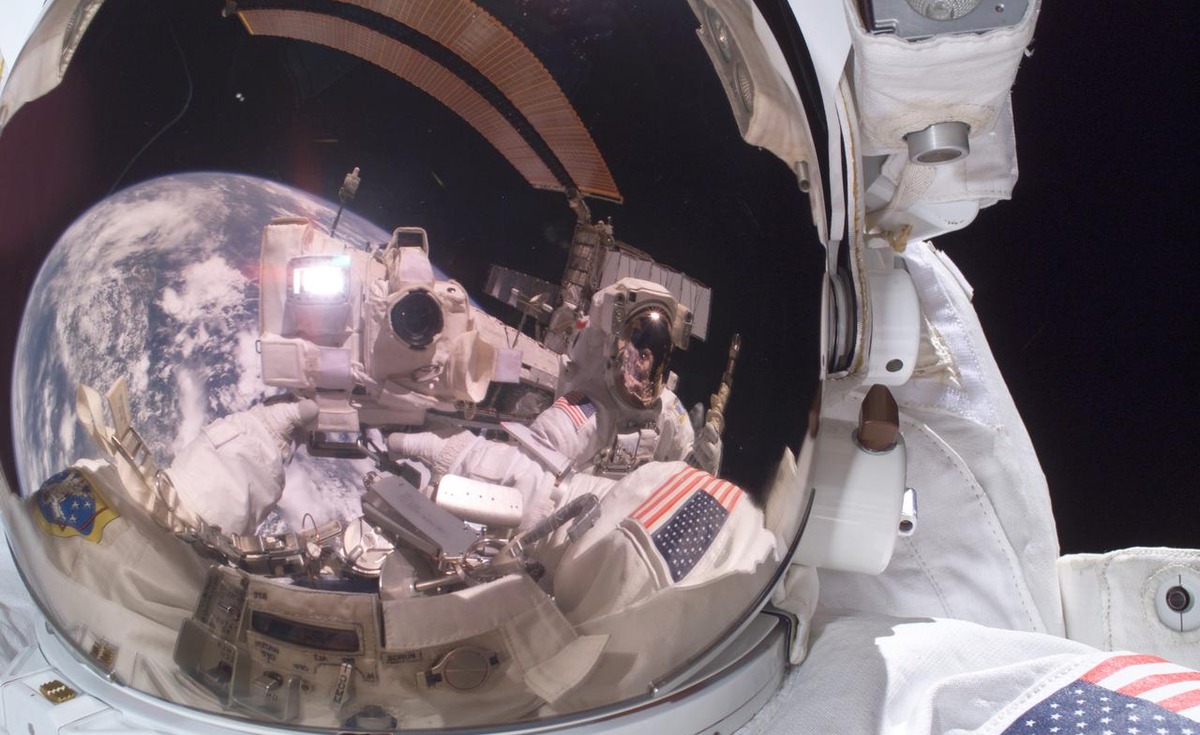
Consequently, an **Extravehicular Mobility Unit (EMU)** is not a garment or clothing; it is a self-contained, anthropomorphic, one-person spacecraft engineered to sustain human metabolic life, physical mobility, and delicate manual dexterity within the lethal void for up to eight continuous hours.
The Extravehicular Mobility Unit (EMU): Multi-Layer Laminate Architecture
The operational American spacesuit deployed on the Space Shuttle and International Space Station—the **Extravehicular Mobility Unit (EMU)**—is composed of fourteen distinct structural, pneumatic, and thermal material layers, massing approximately 145 kilograms uncrewed.
The cross-sectional architecture of the EMU comprises three integrated functional shells:
1. **The Pressure Garment Assembly (PGA):**
– **Bladder Layer:** An airtight inner bladder fabricated from urethane-coated nylon that contains the pressurized breathing atmosphere.
– **Restraint Layer:** A high-tensile Dacron polyester webbing shell that surrounds the bladder. In the vacuum of space, a pressurized balloon expands into a rigid sphere; the restraint layer mechanically constrains the bladder, preserving anthropomorphic human joint geometry and preventing ballooning.
2. **Thermal Micrometeoroid Garment (TMG):**
– **Radiation & Insulation Layers:** Five to seven alternating layers of aluminized Mylar and non-woven Dacron scrim, separated by vacuum gaps, creating an impenetrable multi-layer insulation (MLI) blanket that halts radiative heat transfer.
– **Micrometeoroid Bumper:** Dual layers of high-strength **Kevlar** and **Nomex** fabric, engineered to disintegrate and absorb the kinetic impact shock of hypervelocity micrometeoroid particles.
– **Outer Protective Shell:** Woven **Ortho-Fabric**—a blend of Gore-Tex (expanded PTFE), Kevlar, and Nomex. Ortho-fabric is flame-resistant, tears-resistant, provides high optical reflectivity against solar radiation, and resists atomic oxygen erosion in low Earth orbit.
| Spacesuit Subsystem | Operating Pressure / Fluid | Primary Material Composition | Key Physiological Function | Ergonomic Hazard |
|---|---|---|---|---|
| Pressure Bladder & Restraint | 29.6 kPa (4.3 psi) Pure O2 | Urethane-Coated Nylon & Dacron | Prevents ebullism & hypoxia | Joint stiffness during manual tasks |
| Liquid Cooling Garment | Circulating Water (3°C – 10°C) | Spandex + 91m EVA Plastic Tubing | Rejects 200-500W metabolic heat | Required to prevent lethal heatstroke |
| Thermal Micrometeoroid Layer | Vacuum-Spaced Multilayer | Ortho-Fabric (Gore-Tex, Kevlar, Nomex) | Blocks 120°C to -157°C & debris | Stiff multi-layer bending resistance |
| Primary Life Support (PLSS) | 6.2 MPa (900 psi) O2 Tanks | LiOH / METOX + Sintered Sublimator | 8-hour autonomous oxygen & scrub | 145 kg mass (neutral in microgravity) |
| EVA Gloves & RPR Bearings | 29.6 kPa Pressurized Finger Bellows | Molded Silicone + RTV Knuckle Joints | Allows manual tool dexterity | High grip fatigue; onycholysis risk |
Pneumatics and Pressure Chemistry: Pure Oxygen at 4.3 PSI
A foundational engineering trade-off in spacesuit design is **Operating Pressure vs. Mobility**:
– Inside the ISS, the cabin is pressurized to 101.3 kPa (14.7 psi) with an 80/20 nitrogen-oxygen mix.
– If a spacesuit were pressurized to 14.7 psi, the differential pressure against the vacuum of space would make the suit joints as stiff as concrete pipes. The astronaut would expend all metabolic energy simply attempting to bend their fingers or elbows.
– To maximize ergonomic mobility, the EMU operates at a low pneumatic pressure of **29.6 kPa (4.3 psi)**.
However, breathing an atmosphere at 4.3 psi requires two mandatory physiological adaptations:
1. **100% Pure Oxygen:** Under Dalton’s Law of Partial Pressures, 4.3 psi of pure oxygen provides an alveolar oxygen partial pressure ($p\text{O}_2 \approx 220\text{ mmHg}$) that equals terrestrial sea-level breathing, preventing hypoxia.
2. **The Decompression Sickness (Bends) Hazard:** Dropping instantly from the station’s 14.7 psi nitrogen environment down to the suit’s 4.3 psi environment would cause dissolved nitrogen in the astronaut’s blood and joints to rapidly bubble out of solution (Henry’s Law), causing excruciating and potentially fatal **Decompression Sickness (the Bends)**.
To purge nitrogen from body tissues, astronauts must execute an elaborate **Pre-Breathe Protocol**:
– Breathing 100% pure oxygen via a mask for two to four hours prior to EVA.
– Alternatively, sleeping overnight inside the Quest airlock at a reduced pressure of 10.2 psi (the ‘Campout Protocol’) before a final 60-minute in-suit oxygen pre-breathe, scrubbing dissolved nitrogen from bloodstream lipids before hatch opening.
The Liquid Cooling and Ventilation Garment (LCVG): Metabolic Heat Rejection
Inside a perfectly insulated fourteen-layer spacesuit, an astronaut working strenuously outside—wrenching structural bolts, maneuvering 400-kilogram orbital components, and fighting pressurized joints—generates substantial metabolic body heat, averaging **200 to 500 watts of continuous thermal energy**.
Because the vacuum of space prevents heat convection and the multi-layer insulation blocks radiative dissipation, an astronaut without active cooling would suffer heat exhaustion and heatstroke within twenty minutes, drowning in their own perspiration.
To reject metabolic heat, astronauts wear the **Liquid Cooling and Ventilation Garment (LCVG)** directly against their skin:
– A form-fitting body stocking woven from elastic Spandex and nylon, interlaced with **91 meters of miniature medical-grade ethyl vinyl acetate (EVA) plastic tubing**.
– A small electric pump in the backpack continuously circulates chilled, degassed water through the tubing network at a flow rate of 1.8 liters per minute.
– As the water flows directly over the astronaut’s skin, it absorbs metabolic heat via direct conduction.
– The warmed water returns to the backpack’s **Sublimator**, where it flows across porous sintered nickel plates exposed to the vacuum of space.
– The water on the outer pores freezes into a thin ice layer and instantly **sublimates directly from solid ice to water vapor** into the space vacuum. Because sublimation has a massive latent heat of vaporization ($2.8\times 10^6\text{ J/kg}$), it continuously extracts thermal energy, cooling the circulating water loop down to 3°C to 10°C, regulated by a manual comfort temperature valve on the astronaut’s chest.
The Primary Life Support Subsystem (PLSS) Backpack
Mounted to the rigid fiberglass Hard Upper Torso (HUT) of the suit is the **Primary Life Support Subsystem (PLSS)**—the technological brain and life-support core of the EMU:
– **Oxygen Supply:** Two primary high-pressure gaseous oxygen tanks pressurized to 6.2 megapascals (900 psi), storing 0.55 kilograms of oxygen to sustain respiration and pressurization for up to eight hours, supplemented by a 30-minute emergency secondary oxygen pack (SOP).
– **Carbon Dioxide Removal:** Exhaled air is continuously circulated through a canister of **Lithium Hydroxide (LiOH)** or regenerable **Metal Oxide (METOX)** sorbent, which scrubs carbon dioxide via exothermic chemical absorption:
\[ 2LiOH + CO_2 \xrightarrow{} Li_2CO_3 + H_2O \]
– **Trace Contaminant Control:** An activated charcoal bed extracts methane, ammonia, and organic volatile odors generated by human metabolic decay.
– **Avionics & Telemetry (EMU Display and Control Module):** Microprocessor monitors suit pressure, sublimator ice status, battery voltage, and cardiac telemetry, streaming biometrics to mission control and displaying alerts on an illuminated chest display readable via a wrist-mounted mirror.
Spacewalk Biomechanics, Gloves, and Hand Fatigue
The most critical and ergonomically challenging component of any spacesuit is the **EVA Glove**:
– In microgravity, an astronaut does not walk; they maneuver entirely using handrails, tether hooks, and hand grips mounted to the station hull.
– The gloves must maintain 4.3 psi internal pressure while allowing the astronaut’s fingers to grip handrails, actuate delicate power tools (such as the Pistol Grip Tool, PGT), and manipulate small wire connectors.
Pressurized gloves act like stiff rubber springs: every time an astronaut closes their fist, they must exert continuous muscular effort to overcome the pneumatic stiffness of the finger joints. After an eight-hour spacewalk, astronauts experience extreme **Forearm and Hand Muscle Fatigue, Blistering, and Onycholysis (fingernail delamination)** caused by repeated contact with the pressurized silicone finger caps.
To optimize ergonomics:
– Gloves are custom-molded to 3D laser scans of each individual astronaut’s hands.
– Finger joints incorporate miniature sealed rotary bearings and convolute fabric bellows that bend along natural biological knuckle axes.
– Integrated resistance heaters in the fingertips prevent frostbite when gripping freezing metal truss handrails in orbital shadow.
Neutral Buoyancy Laboratory (NBL) Underwater Ergonomic Simulation
Astronauts do not learn to execute an eight-hour spacewalk in space; they master every movement, tool rotation, and tether lock inside NASA’s **Sonny Carter Training Facility Neutral Buoyancy Laboratory (NBL)** in Houston, Texas.
The NBL is the largest indoor swimming pool in the world, holding **23.5 million liters (6.2 million gallons) of filtered water**, measuring 61 meters long, 31 meters wide, and 12 meters deep. Submerged within the pool is a complete 1:1 scale structural mockup of the International Space Station, Japanese Kibo module, Columbus laboratory, and robotic arms.
Astronauts don weighted training versions of the EMU spacesuit:
– Scuba support divers attach lead weights and closed-cell foam blocks to the suit until the astronaut achieves **Neutral Buoyancy**—neither sinking nor floating, with zero net buoyant rotational torque along pitch, roll, and yaw.
– In neutral buoyancy, moving through water simulates the physical sensation of floating in microgravity: objects require continuous counter-forces to move or stop, and every foot or hand movement exerts an equal and opposite reaction torque on the body.
– For every single hour an astronaut spends on an operational EVA outside the space station, they spend seven to ten hours submerged in the NBL rehearsing every procedure, tool swap, and emergency incapacitated-crew-rescue protocol.
The Orion Crew Survival System (OCSS) and High-Altitude Abort Profiles
While the EMU and AxEMU are designed for extravehicular spacewalks in hard vacuum, astronauts inside the spacecraft require an entirely distinct class of protective suit: the **Launch, Entry, and Abort (LEA) Spacesuit**, exemplified by the **Orion Crew Survival System (OCSS)**.
Worn during dynamic flight phases (launch ascent and atmospheric re-entry):
– The OCSS is a lightweight, form-fitting orange pressure suit designed to protect astronauts against sudden cabin depressurization down to hard vacuum, severe G-force accelerations, and post-splashdown ocean survival.
– If the Orion capsule suffers a micro-meteoroid hull puncture at 30,000 kilometers altitude, the OCSS suit automatically snaps shut its mechanical visor and pressurizes to 24 kPa (3.5 psi) with pure oxygen, sustaining crew life for up to six days while Orion executes an emergency abort return to Earth.
– Integrated into the helmet is a high-bandwidth digital communication headset, while the torso integrates liquid cooling, life-raft survival beacons, and specialized restraint harnesses that dissipate 15-G impact shock loads during ballistic abort ocean landings.
Next-Generation Planetary Spacesuits: The Artemis xEMU and AxEMU Architectures
The legacy Shuttle-era EMU was engineered exclusively for microgravity floating outside a space station; it possesses virtually zero lower-body mobility (the legs cannot bend for walking or kneeling).
For NASA’s Artemis lunar landings, exploration demands an entirely new class of spacesuit: **Planetary Surface EVA Suits**, developed through NASA’s Exploration Extravehicular Mobility Unit (xEMU) and commercialized by Axiom Space (AxEMU):
1. **Rear-Entry Architecture:** Instead of a modular two-piece suit (which requires struggling into pants and a separate torso), the astronaut climbs into the suit through a hinged hatch in the back of the backpack, eliminating waist disconnect leaks.
2. **Bearings and Planetary Mobility:** Sealed rotary bearings at the waist, hips, thighs, and ankles allow astronauts to walk, crouch, kneel to collect geological core samples, and climb steep crater slopes without fighting pneumatic pressure.
3. **Advanced Cryogenic Thermal & Dust Mitigation:** The lunar South Pole presents an ultra-abrasive hazard: electrostatic, razor-sharp lunar regolith dust. AxEMU incorporates dust-shedding hydrophobic outer coatings, mechanical seal lip baffles, and upgraded thermal insulation to withstand -230°C permanently shadowed crater environments, preparing humanity for the exploration of the Moon and the crewed colonization of Mars.