🚀 Orbital Science Overview: Robotic Lunar Exploration
This monograph provides deep technical documentation covering propulsion physics, orbital mechanics, telemetric data, and geochemical planetary science, published under the editorial oversight of Lead Mission Historian Annamae Turner.
The Golden Era of Soviet Lunar Probes: Luna 2, 9, 16, and the Lunokhod Rovers
Long before human boots touched the Sea of Tranquility, the foundational principles of lunar navigation, soft-landing survivability, automated sample return, and robotic roving were established by the ambitious Luna program conducted by the Soviet Union between 1959 and 1976.
The historical trajectory of robotic lunar discovery began on September 14, 1959, when **Luna 2** became the first human artifact to impact the lunar surface, proving that the Moon possessed no measurable global dipole magnetic field or trapped radiation belts. Less than a month later, **Luna 3** executed a translunar looping trajectory around the Moon, utilizing an automated AFA-E1 film camera, in-flight chemical developer tank, and cathode-ray television scanner to transmit the first grain-filled images of the heavily cratered lunar far side—a hemisphere never before witnessed by human eyes.
On February 3, 1966, **Luna 9** achieved the first successful autonomous soft landing on another celestial body in Oceanus Procellarum (Ocean of Storms). Prior to Luna 9, several prominent astrophysicists hypothesized that the lunar surface was covered by a bottomless layer of electrostatic dust that would swallow any landing spacecraft. Luna 9’s petal-shaped spherical lander, ejected via landing radar altimetry and cushioned by an inflatable airbag shock system, proved that the lunar regolith possessed structural bearing capacity sufficient to support heavy machinery.
In September 1970, **Luna 16** accomplished humanity’s first completely autonomous robotic sample return mission. Landing in Mare Fecunditatis, the spacecraft deployed an automated drill arm capable of boring 35 centimeters into the basalt, transferred the core sample into a spherical re-entry capsule mounted atop an ascent rocket, and launched directly from the lunar surface back to Earth without human intervention, returning 101 grams of extraterrestrial material.
This was followed by **Lunokhod 1** (November 1970) and **Lunokhod 2** (January 1973)—the world’s first planetary rovers. Massing 840 kilograms and resembling pressurized bathtubs mounted on eight wire-mesh motorized wheels, the Lunokhod rovers were powered by solar arrays and heated through the brutal 14-day lunar night by Polonium-210 radioisotope thermal decay units. Operated remotely by a five-man ground control team in Crimea via real-time television feeds, Lunokhod 1 traveled 10.5 kilometers across Mare Imbrium, transmitting over 20,000 telemetric television frames and conducting hundreds of soil penetrometer resistance tests.
The Renaissance of Lunar Orbital Mapping: Clementine, Lunar Prospector, and LRO
Following the conclusion of Luna 24 in 1976, lunar exploration entered a 18-year dormant hiatus as planetary science prioritized inner and outer solar system exploration. The modern renaissance began in 1994 with the launch of the joint NASA/DoD **Clementine** spacecraft, followed in 1998 by **Lunar Prospector**.
Clementine utilized ultraviolet, visible, and near-infrared cameras to perform the first global multispectral mineralogical mapping of the Moon, revealing the compositional dichotomy between the titanium-rich mare basalts and the anorthositic highlands. Crucially, Clementine conducted a bistatic radar experiment, beaming radio waves into the shadowed south polar craters; the reflected signals received by the Deep Space Network on Earth displayed high circular polarization ratios (CPR) characteristic of water ice deposits.
Lunar Prospector confirmed these hints using a **Neutron Spectrometer**. By measuring the energy distribution of neutrons kicked out of the lunar regolith by cosmic ray bombardment, Lunar Prospector detected strong signatures of epithermal neutron leakage suppression over both lunar poles. Because epithermal neutrons are specifically moderated by collision with hydrogen atoms of equal mass, the data proved that the polar regolith was enriched with massive concentrations of hydrogen, predominantly in the form of water ice molecules.
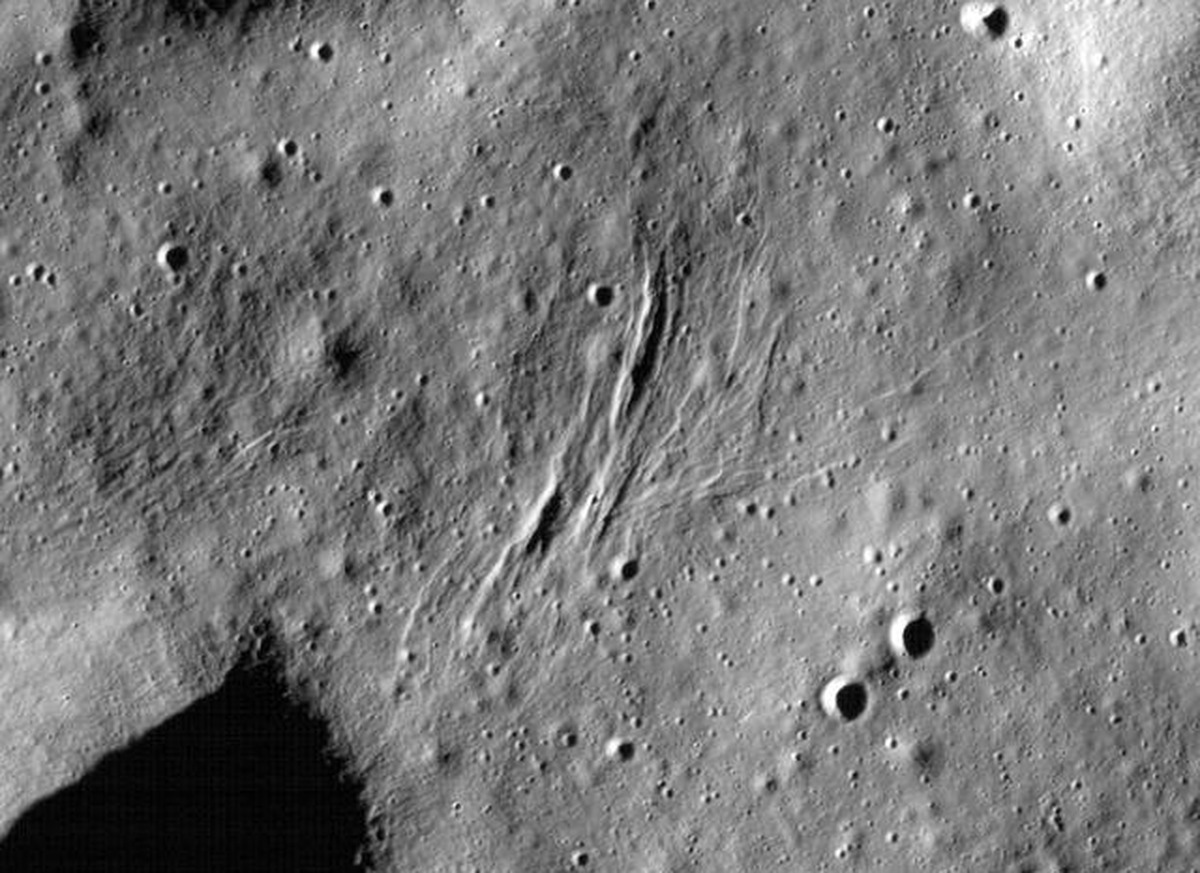
In June 2009, NASA deployed the **Lunar Reconnaissance Orbiter (LRO)** into a 50-kilometer polar mapping orbit. Equipped with seven cutting-edge instruments—including the Lunar Orbiter Laser Altimeter (LOLA), the Diviner Lunar Radiometer, and the Lunar Reconnaissance Orbiter Camera (LROC)—LRO has mapped the lunar topography down to sub-meter resolution for over 15 years, discovering subsurface lava tubes, cataloging active thermal variations from +120°C in direct sunlight to -246°C in polar cold traps, and identifying candidate landing sites for international and commercial lander fleets.
| Robotic Mission | Country / Agency | Landing Region | Payload / Key Scientific Achievement | Historical Status |
|---|---|---|---|---|
| Luna 9 (1966) | Soviet Union | Oceanus Procellarum | First soft landing; disproved deep dust theory | Pioneered planetary radar landing |
| Lunokhod 1 (1970) | Soviet Union | Mare Imbrium | First planetary rover; 10.5 km traverse | Radioisotope thermal decay survivability |
| Chang’e 4 (2019) | China (CNSA) | Von Kármán (Far Side) | First landing on lunar far side; Queqiao relay | Explored South Pole-Aitken Basin crust |
| Chang’e 5 (2020) | China (CNSA) | Mons Rümker (Oceanus) | Robotic drill & scoop returned 1.73 kg basalt | Proved 2.0-billion-year volcanism |
| Chandrayaan-3 (2023) | India (ISRO) | 69.37° S (South Polar) | First soft landing in proximal south pole | Discovered surface sulfur & thermal insulation |
China’s Chang’e Program: Automated Sample Return and the Historic Far-Side Landing
The China National Space Administration (CNSA) executed one of the most disciplined, multi-phase lunar exploration roadmaps in modern aerospace history through its **Chang’e Program** (named after the Chinese mythological goddess of the Moon). Structured into three sequential phases—Orbiting (Phase 1), Soft Landing & Roving (Phase 2), and Robotic Sample Return (Phase 3)—the program achieved a series of historic milestones.
The pinnacle of Phase 2 occurred on January 3, 2019, when **Chang’e 4** executed humanity’s first successful soft landing on the **lunar far side**, touching down inside the 180-kilometer-wide Von Kármán crater within the vast South Pole-Aitken (SPA) Basin. Because the Moon is tidally locked to Earth, direct radio communications with the far side are physically impossible due to the bulk of the lunar sphere.
To resolve this fundamental physical barrier, CNSA pre-deployed the **Queqiao Relay Satellite** into an Earth-Moon L2 halo orbit located 65,000 kilometers beyond the far side. Utilizing a 4.2-meter deployable parabolic antenna, Queqiao acted as an orbital telemetric bridge, maintaining simultaneous line-of-sight to the ground stations in China and the Chang’e 4 lander on the surface.
Chang’e 4 deployed the **Yutu-2 (Jade Rabbit 2)** rover, which has operated continuously for over five years, driving across the ancient impact basin. Utilizing Lunar Penetrating Radar (LPR), Yutu-2 mapped the subsurface stratigraphy down to depths of 330 meters, revealing layers of porous volcanic ejection regolith interbedded with multiple basalt flows.
In December 2020, **Chang’e 5** executed a complex robotic sample return architecture:
1. The lander touched down in Northern Oceanus Procellarum near Mons Rümker—a geologically young volcanic province.
2. An automated drill collected core samples down to 2 meters, while a robotic scoop harvested surface soil, gathering 1,731 grams of material.
3. The samples were sealed in an ascent stage, which launched into lunar orbit, conducted the **first automated rendezvous and docking in lunar orbit since Apollo**, transferred the sample canister into an Earth return orbiter, and landed in Inner Mongolia.
Radiometric dating of the Chang’e 5 basalts revealed they were merely 2.0 billion years old, proving that the Moon remained volcanically active more than a billion years longer than previously deduced from Apollo samples.
This was followed in June 2024 by **Chang’e 6**, which repeated this complex orbital rendezvous architecture on the lunar far side, returning the **first-ever samples collected from the Moon’s far side mantle impact melts**.
India’s Chandrayaan Missions: Polar Discovery and the Chandrayaan-3 Touchdown
The Indian Space Research Organisation (ISRO) emerged as a major player in international lunar science through its cost-effective and technologically bold **Chandrayaan program**.
Launched in October 2008, **Chandrayaan-1** carried a payload of eleven scientific instruments, including NASA’s Moon Mineralogy Mapper (M3). On November 14, 2008, Chandrayaan-1 ejected the Moon Impact Probe (MIP), which impacted near Shackleton Crater at the South Pole. Spectroscopic data from M3 analyzed during the impact plume and polar surface scans detected distinct hydroxyl (OH) and water (H2O) absorption features at the 2.8 to 3.0 micrometer wavelength bands, providing definitive empirical confirmation that water molecules were bound within the surface regolith of the Moon.
Building upon this discovery, ISRO designed **Chandrayaan-2** (2019), consisting of an advanced high-resolution orbiter, the Vikram lander, and the Pragyan rover. While the Vikram lander suffered a guidance software anomaly during final braking that led to a hard impact, the Chandrayaan-2 orbiter remains fully operational in polar orbit, supplying the highest-resolution optical imagery (0.32 meters per pixel) and dual-frequency synthetic aperture radar (DF-SAR) data available to the international scientific community.
ISRO demonstrated remarkable technological resilience on August 23, 2023, when **Chandrayaan-3’s Vikram lander** achieved a historic soft landing at 69.37° S, 32.35° E, making India the fourth nation to successfully land on the Moon and the **first nation in human history to land in the proximal lunar southern polar region**.
Vikram deployed the six-wheeled Pragyan rover, which explored the polar terrain using two advanced geochemical sensors:
– **Laser-Induced Breakdown Spectroscopy (LIBS):** Fired high-energy nanosecond laser pulses into the regolith, generating a micro-plasma plume whose atomic emission lines confirmed the presence of aluminum, calcium, iron, chromium, titanium, manganese, silicon, and crucially, localized concentrations of elemental **Sulfur (S)**.
– **Alpha Particle X-ray Spectrometer (APXS):** Utilized Curium-244 radioactive decay sources to quantify major and minor rock-forming elements, revealing that the highland soil near the landing site was composed of ferroan anorthosite with uniform mineral distribution.
– **ChaSTE (Chandra’s Surface Thermophysical Experiment):** Inserted a thermal probe 10 centimeters into the polar regolith, recording a staggering 60°C temperature drop between the solar-baked surface (+50°C) and 8 centimeters depth (-10°C), proving that lunar regolith functions as one of the most efficient thermal insulators in the solar system.
Commercial Lunar Payload Services (CLPS) and the Future Robotic Fleet
As lunar exploration enters the mid-2020s, NASA has initiated the **Commercial Lunar Payload Services (CLPS)** initiative. Rather than designing, building, and operating bespoke robotic landers, NASA purchases commercial payload delivery services from private aerospace companies, catalyzing a competitive cislunar transport market.
In February 2024, Intuitive Machines’ **Nova-C lander (Odysseus / IM-1)** became the first commercial spacecraft to land on the Moon and the first American spacecraft to touch the lunar surface since Apollo 17 in 1972. Touching down near Malapert A crater at 80° South latitude, IM-1 successfully operated commercial laser retroreflectors, radio frequency mass gauges for cryogenic fuel tracking, and astronomical radio receivers.
Upcoming robotic missions will dramatically expand polar surface science:
– **VIPER (Volatiles Investigating Polar Exploration Rover):** Equipped with a 1-meter regolith drill and mass spectrometers to create the first 3D geochemical resource maps inside permanently shadowed crater floors.
– **Lunar Trailblazer:** A high-resolution orbital spectrometer designed to map the form, abundance, and diurnal temperature migration of water molecules across the lunar surface.
– **Commercial In-Situ Pilot Plants:** Experimental microwave sintering reactors and molten regolith electrolysis units designed to melt lunar dust into solar cells, landing pads, and structural radiation shelters.
Through this coordinated synergy of historical government agency heritage, international exploration partnerships, and dynamic commercial payload delivery systems, robotic lunar probes are transforming the Moon from a static historical monument into an active, scientifically vibrant industrial frontier of human civilization.
Thermal Survival Across the 14-Day Lunar Night: Cryogenic Electronics & RHUs
One of the most extreme physical environments in the solar system occurs on the surface of the Moon during the **lunar night**. Because the Moon’s synodic rotation period takes approximately 29.5 Earth days, any landing site outside the polar illuminated massifs experiences approximately 354 continuous hours (14.75 Earth days) of total darkness.
During this nocturnal phase:
– Ambient surface temperatures plummet from +120°C in direct midday sunlight down to -130°C on equatorial plains and -180°C to -230°C in polar depressions.
– Solar photovoltaic generation drops to absolute zero.
– Standard lithium-ion battery chemistries freeze, undergoing internal dendritic electrolyte crystallization that permanently destroys energy storage capacity.
– Semiconductor silicon microprocessors and solder joints undergo severe thermal expansion coefficient mismatch, fracturing circuit board traces.
To survive the lunar night, robotic missions utilize specialized thermal architectures:
– **Radioisotope Heater Units (RHUs):** Compact pellet-sized thermal units containing Plutonium-238 (or Americium-241 in European architectures) that continuously generate 1 watt of thermal heat through natural radioactive decay, keeping battery compartments above -20°C without consuming electrical power.
– **Thermal Louvers and Variable Conductance Heat Pipes (VCHPs):** Mechanically responsive bimetallic louvers that open during the day to radiate excess heat into space and snap shut during the night, trapping internal thermal energy like an insulated thermos bottle.
– **Wide-Bandgap Semiconductor Electronics:** Developing silicon carbide (SiC) and gallium nitride (GaN) microchips capable of operating down to cryogenic temperatures (-180°C) without external heating, paving the way for low-mass autonomous lunar landers capable of multi-year operational lifespans.
The Geopolitical and Scientific Significance of the Lunar Stratigraphy
Robotic lunar exploration has evolved beyond scientific curiosity into a strategic pillar of global planetary science and international space policy. Because Earth possesses active plate tectonics, hydrological erosion, and atmospheric weathering, all geological evidence of our planet’s first billion years has been entirely recycled and erased from the terrestrial rock record.
The Moon, by contrast, is a **fossilized planetary museum**:
– Its ancient anorthositic highlands preserve the pristine crustal record of the **Late Heavy Bombardment** (4.1 to 3.8 billion years ago)—a cataclysmic epoch during which hundreds of thousands of giant asteroids swept through the inner solar system, impacting Earth, Moon, and Mars.
– By dating robotic drill cores collected across varied lunar craters (from Chang’e 5’s young basalts to Chandrayaan-3’s polar regolith), scientists calibrate the absolute crater-density chronological clock used to date surface ages across Mercury, Mars, and the outer icy moons.
– Furthermore, the Moon’s regolith has captured four billion years of unshielded **solar wind implantation**, trapping isotopes of Helium-3, hydrogen, nitrogen, and noble gases emitted by the evolving Sun, providing a continuous historical log of solar luminosity and stellar evolution.
Thus, robotic landers and rovers are not merely mapping dust; they are uncovering the deepest chapters of Earth’s origin, the chemical evolution of planetary systems, and the cosmic environment that permitted life to emerge on our home world.