Mars Exploration
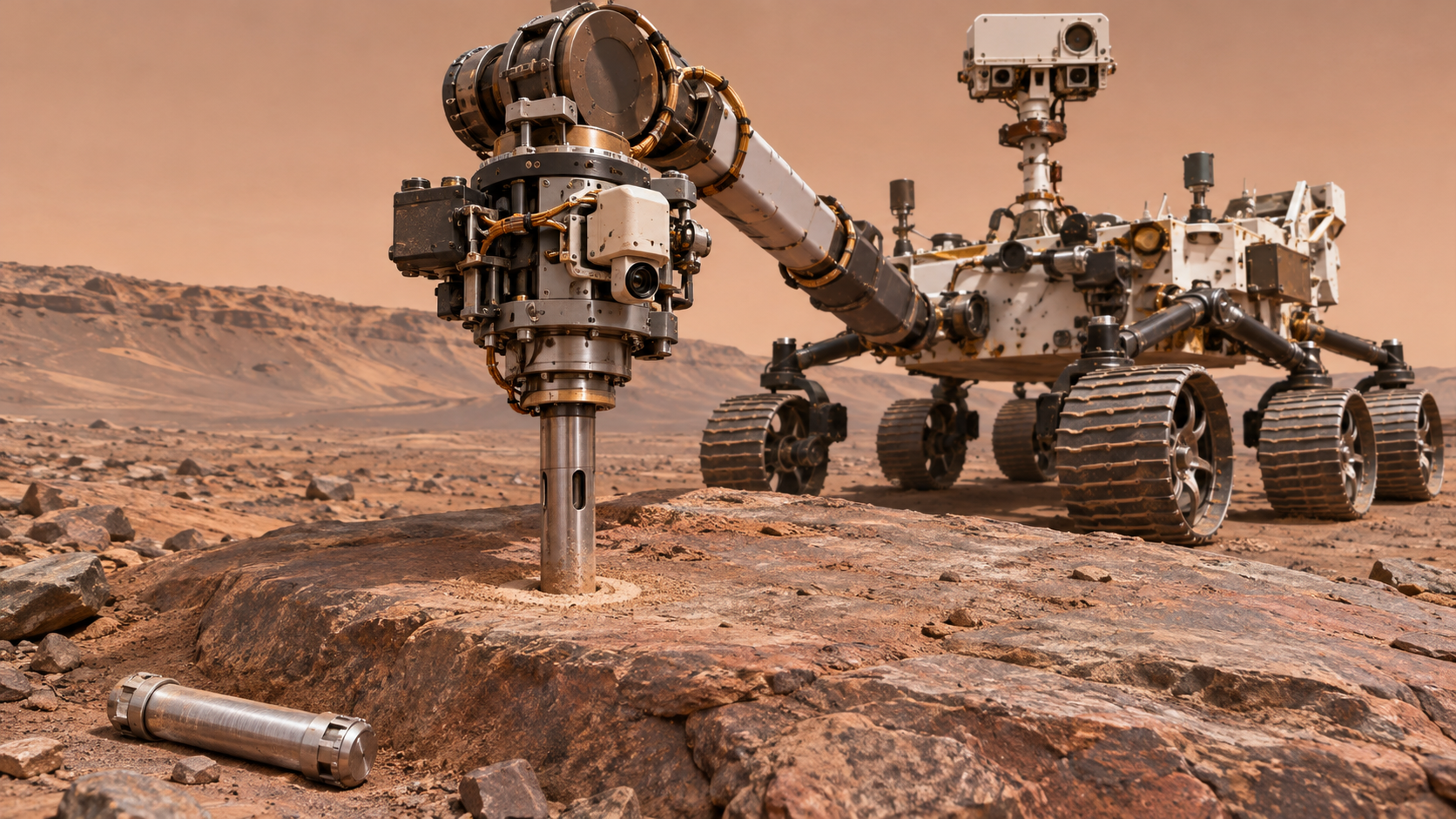
Perseverance drills a narrow cylinder out of a Martian rock, catches it in a titanium tube, and passes the tube into its own body for inspection and sealing.
The rover can carry the sealed tube onboard or set it down at a recorded location for possible retrieval. The sequence starts well before the drill touches rock. The science team first has to decide what a particular sample could reveal and record enough about the site to make sense of the sample later.
At the outcrop
How the team chooses where to drill
A rock in Jezero Crater can preserve clues to a particular chapter of Mars’s history. A sedimentary layer might record conditions when material settled in or near the crater’s ancient lake. An igneous rock can help researchers investigate a different event, such as when molten rock cooled. The team looks at the colors, textures, and relationships between rocks before deciding which targets are worth a tube.
Surface dust and weathering can make a rock’s exterior difficult to interpret. Perseverance can grind a shallow patch to expose fresher material and use instruments on its robotic arm to study it up close. PIXL helps map the elements in the exposed surface. SHERLOC uses ultraviolet light to investigate minerals and look for signs of organic compounds. These observations help scientists decide which nearby spot to core and what questions to ask about it.
Photographs preserve details that will never fit in the tube. An image can show where the drill hole sits within a band of rock, whether that band crosses a fracture, or how it connects to a neighboring layer. Later, if a lab finds a mineral associated with water, that record can help researchers ask whether the mineral formed throughout the rock or appeared in a vein after the rock had already formed.
At the drill
The bit cuts around a cylinder of rock
The drill sits on the rotating turret at the end of Perseverance’s large front arm. For a rock sample, the drill uses a hollow coring bit with a clean sample tube fitted inside. The arm brings the bit against the chosen spot and holds it in position. The bit rotates as it cuts. The drill can also add quick hammering blows to help it advance.
As the bit cuts a ring into the rock, the material in the center enters the sample tube. A full-size core is about 13 millimeters across and 60 millimeters long, roughly the size of a short stick of chalk. A sample may contain a cylinder or smaller pieces, depending on how the rock behaves during drilling. Preserving pieces of the original rock gives scientists a chance to examine features such as thin layers and boundaries between mineral grains.
Inside the rover
A carousel passes the tube to a smaller arm
Once the drill retracts, the large arm brings the coring bit back to the rover. It docks the bit at a mechanism called the bit carousel, which handles drill bits and transfers them between the external drill and the sampling equipment inside. The carousel also helps supply the drill with a bit carrying an empty tube before the next collection.
Inside the rover, a much smaller sample-handling arm removes the tube and carries it between processing stations. The two arms have very different jobs. The front arm has to hold a heavy drill steady against an uneven rock face. The internal arm makes short, precise movements to position the tube for measurements, imaging, and sealing. The carousel gives them a fixed point for the handoff.
People on Earth plan sampling operations and review the results. Perseverance carries out the individual movements on Mars using its onboard controls. At interplanetary distances, signals take minutes to travel each way. The rover’s mechanisms have to complete a handoff without someone on Earth steering each motion as it happens.
Before storage
The rover checks the contents and closes the tube
The internal arm moves the tube to a station that assesses how much material it contains and to another that photographs it. Taken together, the measurement and image help the team distinguish a substantial core from a partial sample or a tube with very little material. That matters because it can guide the next decision at the outcrop. The team might already have the material it needs, or it might choose another place to drill.
After inspection, a station installs and activates a seal designed to make the tube airtight. The handling arm then places the closed tube in an onboard storage position. Keeping each sample in a separate sealed container limits contact with dust and with material collected at other sites. That separation would matter in a lab, where researchers might compare tiny traces of a substance across tubes from different locations.
Perseverance also carries witness tubes. These are exposed during operations to help investigators assess what the rover or its surroundings might have contributed to a sample. If researchers eventually analyze the collection on Earth, the witness tubes can help them interpret an unexpected trace. For example, finding the same substance in a rock tube and a witness tube would give them a reason to investigate where it came from before drawing a conclusion about the rock.
Some tubes stay with the rover. Others sit at a depot.
In this mission, caching means keeping sealed samples in known locations so they could be collected later. Perseverance can store tubes internally, and it has also demonstrated how to place them on the ground. Both approaches preserve the link between a particular tube and its collection record.
Onboard storage
The sample-handling arm places the sealed tube in an assigned storage position inside Perseverance. Carrying tubes lets the rover continue sampling as it moves between geological sites. Each tube has an identity that can be matched to the original target, the images taken during collection, and the other measurements made nearby.
The Three Forks depot
Perseverance placed ten tubes on the Martian surface at a site called Three Forks. The tubes were set down individually with space between them, and their positions were documented. That gives a possible retrieval mission a map of individual tubes and room to approach them, even if the rover is elsewhere.
What a future lab could learn from a sealed tube
A core and its field record answer different questions. A laboratory might identify minerals at a scale the rover’s instruments cannot resolve or examine the order in which grains and mineral veins formed. The photographs and field observations would show where that material sat within the larger outcrop. Together, they could help researchers reconstruct how a particular rock formed and what happened to it afterward.
Does Perseverance collect only solid rock?
Its sampling system can also collect regolith, the loose material on the Martian surface. A sample of grains and dust can help scientists investigate how surface material forms, moves, and changes. A rock core provides a closer look at the particular layer or body of rock it came from.
How would the tubes get back to Earth?
Perseverance handles collection, sealing, and storage on Mars. Recovering the tubes, launching them from the Martian surface, and delivering them to Earth would require separate spacecraft and a future mission.