Space Exploration
Six seconds on an asteroid. Seven years from launch to landing.
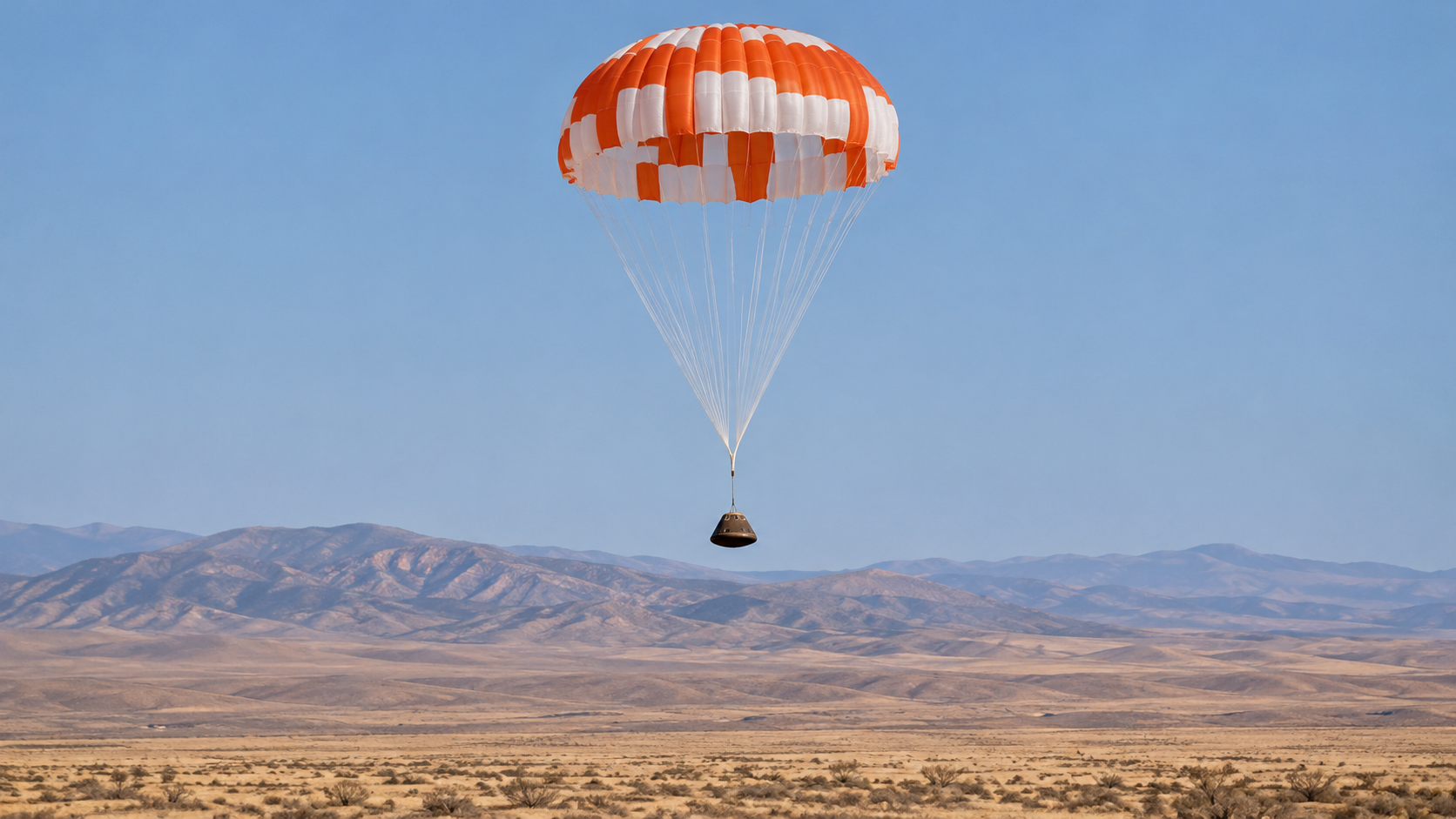
NASA’s OSIRIS-REx collected rock and dust from asteroid Bennu by briefly touching the surface and firing a burst of nitrogen gas. The spacecraft sealed the material inside a return capsule, carried it back to Earth, and released it on a path to Utah. A parachute brought the capsule down, where a recovery crew secured it for laboratory study.
- Target asteroid
- Bennu
- Rock and dust recovered
- 121.6 grams
- Capsule landed
- September 24, 2023
Finding a place to touch down
OSIRIS-REx launched on September 8, 2016, and reached Bennu on December 3, 2018. The spacecraft had come to sample a carbon-rich asteroid whose material could help scientists investigate the early solar system. Before it could collect anything, the team needed to know where fine material lay, how close the spacecraft could safely approach, and whether the sampling arm could reach the ground without the rest of the spacecraft hitting a rock.
Images sent back on arrival complicated that plan. The team had expected to find broad areas of relatively smooth terrain. Instead, prominent boulders covered much of the surface. A patch that looked promising from farther away could turn out to be too small or hemmed in by rocks when photographed up close. The spacecraft spent nearly two years surveying Bennu before attempting to collect a sample.
The team chose a site called Nightingale, inside a crater in Bennu’s northern hemisphere. It offered material that appeared small enough for the collector, but the surrounding rocks left little room for error. Engineers used images of Bennu to give the spacecraft a set of landmarks. During the approach, the onboard navigation system could compare new camera views with those known features to estimate where the spacecraft was and whether it was still headed for a safe patch.
That ability mattered because commands and images take time to travel between Earth and a distant spacecraft. Mission controllers could prepare the sequence and decide when to begin it. Once OSIRIS-REx was descending, the spacecraft had to handle the final adjustments itself. The same boulders that complicated the approach also gave its cameras features to recognize.
How a puff of gas picked up asteroid rock
On October 20, 2020, OSIRIS-REx extended its sampling arm and descended toward Nightingale. The device at the end of the arm was called the Touch-And-Go Sample Acquisition Mechanism, or TAGSAM. The name describes the maneuver. The head would make brief contact, collect material, and move away with the spacecraft. Most of the vehicle would remain above the surface.
Bennu has extremely weak gravity. A burst of pressurized nitrogen directed at the ground could set loose particles in motion, and the collector head was designed to catch some of that rock and dust as it moved. The gas came from the spacecraft. It could do its job at the surface even though there was effectively no atmosphere around the asteroid.
The sampler touched Bennu for roughly six seconds before the spacecraft fired its thrusters to back away. In the images, the surface gave way readily around the head. That behavior was a result in its own right. The material at Nightingale offered surprisingly little resistance where the sampler pressed into it. A camera looking down from above could show the shape of the terrain, but the contact revealed something about how the ground behaved when disturbed.
A full collector created a new problem
Pictures taken after the maneuver showed that the head had gathered plenty of material. They also showed grains drifting away. The team concluded that larger pieces had likely wedged open parts of the flap designed to hold the sample inside. Moving the arm unnecessarily could give more of the captured material a chance to escape.
The team dropped a planned maneuver to estimate the sample’s mass and moved ahead with stowing it. The arm placed the collection head inside the return capsule, where the head was secured and the capsule closed. That put a protective enclosure around the material for the journey home. The exact mass could wait until the sample was in a laboratory.
Getting a capsule from space to the Utah desert
OSIRIS-REx began its trip home on May 10, 2021. For more than two years, the capsule remained aboard the spacecraft as it traveled toward an encounter with Earth. The final delivery depended on getting two trajectories right. The capsule had to enter the atmosphere on a path that would bring it to the recovery area. After release, the spacecraft had to change course to fly safely past Earth.
On September 24, 2023, OSIRIS-REx released the capsule while it was still about 102,000 kilometers from Earth’s surface. From there, the capsule continued toward the planet on its own. The spacecraft performed a maneuver to divert away. It went on to an extended mission, OSIRIS-APEX, headed for asteroid Apophis.
Atmospheric entry
The capsule met the atmosphere at roughly 12 kilometers per second. A heat shield protected the interior while the atmosphere slowed the capsule.
Parachute descent
The small stabilizing parachute, called a drogue, failed to deploy as intended. The main parachute opened and slowed the capsule for landing.
Landing
The capsule came down at the Utah Test and Training Range, where the recovery team was ready to retrieve it.
NASA later traced the likely cause of the drogue problem to inconsistent wiring labels in the design documentation. The labels appear to have led to release signals firing out of order. The main parachute carried the capsule through the final descent, and the sample arrived safely. That distinction matters when retelling the mission. The planned descent had two parachutes working in sequence, while the actual recovery succeeded after the first part of that sequence went wrong.
The last leg went through a clean room
Landing put Bennu’s material back on Earth, but the recovery crew still had to protect it from Earth’s environment. Dust from the desert, moisture in the air, and material transferred during handling could complicate later measurements. This mattered especially for researchers planning to identify small amounts of particular substances in the sample.
A helicopter carried the capsule to a temporary clean room at the range. There, the team set up a flow of nitrogen to help protect the sample canister from the surrounding air. Nitrogen had served a different purpose at Bennu, where a short burst had kicked particles into the sampling head. In Utah, a steady supply helped maintain a controlled environment around the returned material.
The sample then went to NASA’s Johnson Space Center in Houston for curation. That work includes opening and documenting the material under controlled conditions, separating portions for analysis, and preserving material for future study. Once the team had recovered and weighed the material, NASA reported a total of 121.6 grams. The mission goal was at least 60 grams, so the return amounted to just over twice the target.
Why bringing the rock home matters
A spacecraft can map an asteroid and measure properties from orbit. A returned sample lets researchers ask questions at the scale of an individual grain. A lab can examine which minerals sit next to one another, compare the composition of several fragments, or use different instruments on portions from the same collection. Those comparisons let researchers test interpretations they first developed from images and remote measurements.
The material also comes with a documented collection site. Scientists can compare the fragments with images of Nightingale and with observations of other parts of Bennu. They know where the sampler touched, how it gathered the material, and how the sample was handled once it reached Earth. That record matters when a finding depends on distinguishing a feature of the asteroid from something introduced during recovery or analysis.
Bennu’s sample will outlast the experiments the mission team could plan before launch. Preserved material gives future researchers a chance to revisit today’s findings with more sensitive instruments or entirely new questions. For a mission that spent years getting ready for a few seconds of contact, that may be the longest-lasting result.