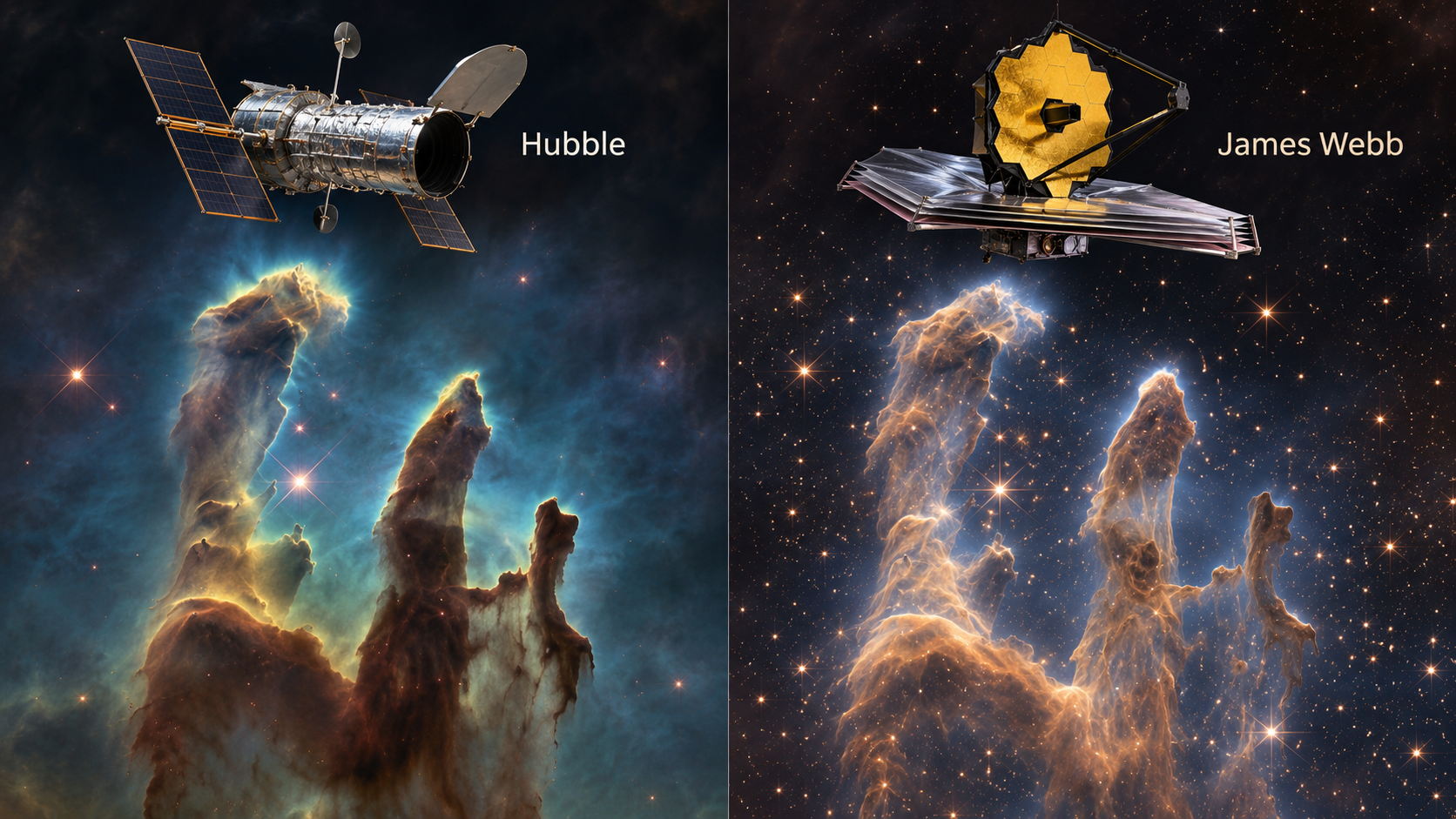
Hubble gives astronomers a view in ultraviolet, visible, and some near-infrared light. James Webb starts at the red edge of visible light and reaches much farther into the infrared. That difference helps explain why Hubble can map ultraviolet auroras on Jupiter while Webb can pick out stars forming inside dusty clouds.
Point both telescopes at the same object and one may show a glowing cloud while the other reveals stars inside it. Which view you need depends on where the light you want to measure falls on the spectrum.
Where their views overlap
Ultraviolet light has shorter wavelengths than visible light. Beyond the red end of the visible spectrum lies infrared, where wavelengths are longer. Hubble comes into its own on the shorter-wavelength side of this comparison, and Webb extends the view toward longer wavelengths. Both can observe in parts of the red and near-infrared, although the exact wavelengths available depend on the instrument and filter.
| Feature | Hubble | James Webb |
|---|---|---|
| Approximate wavelength coverage | 0.115–2.5 micrometers | 0.6–28.8 micrometers |
| Primary mirror | 2.4 meters across, single mirror | About 6.5 meters across, 18 segments |
| Location | Low Earth orbit | Orbits near the Sun–Earth L2 point, about 1.5 million kilometers from Earth |
| Example observations | Visible galaxy structure and ultraviolet light from hot gas | Dust-hidden stars, redshifted galaxies, and infrared signatures of atmospheric molecules |
Why mirror size tells only part of the story
A larger mirror collects more light over a given exposure, which helps when a target is faint. It also helps a telescope distinguish details that sit close together on the sky. But the smallest detail a telescope can resolve depends on wavelength as well as mirror diameter. Longer wavelengths spread out more at a given mirror size. Webb’s larger mirror helps compensate for the longer wavelengths it was built to observe.
Imagine two stars so close together in the image that their light nearly blends into one spot. Whether astronomers can separate them depends in part on the size of each blur at the wavelength being recorded. A Hubble image taken in visible light can resolve detail on a scale comparable to a Webb image taken at some near-infrared wavelengths. Within Webb’s own observations, a shorter-wavelength near-infrared image can resolve finer structure than a longer-wavelength mid-infrared image.
Webb also has to contend with heat. Warm material emits infrared light, so a warm telescope could add its own glow to the measurement. Webb’s sunshield keeps its optics and instruments on a cold side sheltered from the Sun, Earth, and Moon. Its mid-infrared instrument uses additional cooling. The orbit near L2 supports this arrangement by keeping those three sources of heat and light in the same general direction from the spacecraft.
One star nursery in three kinds of light
The Pillars of Creation make the difference easy to see. The columns in this part of the Eagle Nebula contain gas and dust, and stars are forming in the region. In visible light, dust blocks or scatters much of the light coming from behind it. At some infrared wavelengths, more of that starlight reaches the telescope. Dust can also emit infrared light of its own, giving astronomers another way to trace its distribution.
Hubble in visible light
The columns appear dark and solid in places. Bright edges and the surrounding glow help trace the shape of the cloud against its background.
Webb in near-infrared
More stars emerge around and within the pillars. Some newly formed stars become visible where thick-looking dust dominated the visible-light image.
Webb in mid-infrared
The distribution of dust stands out. Many stars prominent in the near-infrared view fade here, while dusty material around some young stars becomes more conspicuous.
Which image should an astronomer use to trace the outline of the cloud? Hubble’s visible view gives a clear starting point. Want to identify likely young stars hidden in the region? Start with Webb’s near-infrared data, then check the mid-infrared data for signs of surrounding dust. Looking at all three also gives researchers a way to distinguish a gap in the visible image from a genuine shortage of stars.
How Webb reaches farther into the early universe
Looking at a distant galaxy means seeing the light it emitted long ago. As that light travels through the expanding universe, its wavelength stretches. Astronomers call this cosmological redshift. For very distant galaxies, light that started out in the ultraviolet or visible range can arrive in the infrared.
Follow one wavelength. At a redshift of 9, light arrives at ten times its emitted wavelength. Ultraviolet light emitted at 0.15 micrometers arrives at 1.5 micrometers, within the near-infrared coverage of both observatories. Visible light emitted at 0.5 micrometers arrives at 5 micrometers, accessible to Webb and beyond Hubble’s range.
That extra coverage matters because different parts of a galaxy’s spectrum carry different clues. Light originally emitted in the ultraviolet is especially useful for finding young, hot stars. Light originally emitted at visible wavelengths adds information about the galaxy’s stars and gas. Measuring both can help astronomers build a fuller picture of a galaxy that looks like a small, faint smudge in an image.
Hubble’s deep-field observations already revealed large numbers of faint, distant galaxies. Webb extends that work with greater infrared reach and sensitivity. Astronomers can use Webb images to identify promising candidates and then collect a spectrum, which separates the light by wavelength. If the spectrum contains a recognizable feature or pattern, its shift can help establish the galaxy’s redshift. A red appearance in a picture alone can also arise from dust or the mix of stars in a galaxy, so researchers use multiple measurements to tell these possibilities apart.
What they see around planets
In our solar system, Hubble’s visible-light observations can track features such as changing cloud patterns on Jupiter. Its ultraviolet instruments can observe Jupiter’s auroras, where particles interact with the upper atmosphere and produce light. Webb can observe Jupiter in infrared bands that highlight different features, from high-altitude hazes to faint rings. The same planet provides several subjects once you choose which light to measure.
Around other stars, both telescopes can study some planets through transit spectroscopy. During a transit, the planet passes in front of its star as seen from Earth. A small fraction of the starlight passes through the edge of the planet’s atmosphere. Scientists compare the spectrum of the star during the transit with its spectrum outside the transit. If the planet blocks slightly more light at certain wavelengths, the pattern can reveal what the atmosphere absorbs.
Hubble’s visible and near-infrared observations can help researchers investigate how a planet’s atmosphere scatters light and look for features such as water vapor absorption. Webb spans more of the infrared, where several gases have distinctive absorption bands. Its observations of the gas giant WASP-39 b, for example, identified a carbon dioxide feature near 4.3 micrometers, beyond Hubble’s wavelength coverage. In a published spectrum, the evidence looks like a change in how deeply the planet dims the star at those wavelengths.
The quality of a measurement depends on the planet, its host star, and the atmosphere itself. A hot, large planet passing in front of a bright star can offer an easier measurement than a small rocky planet whose thin atmosphere intercepts very little starlight. Clouds and hazes can also make some features harder to measure. Astronomers use these details to decide which targets and wavelengths have the best chance of answering their question.
How to read the colors in telescope images
Each telescope can take a series of exposures through filters that select different wavelengths. A finished image assigns visible colors to those exposures. For an image assembled from infrared observations, shorter infrared wavelengths might be assigned blue and longer ones red. Those display colors let you see where the different measurements are strongest, even though your eyes are unable to detect the original infrared light.
When a feature changes color between two images, check the captions for the instruments, filters, and wavelengths used. If structure seems to disappear, also consider whether the images have different fields of view, exposure depths, or levels of detail. For a side-by-side comparison, begin with a recognizable landmark, such as the tip of the tallest Pillar of Creation. Then look for stars or dust around it that become more prominent as the wavelength changes.
Common questions
Can Webb see any visible light?
Yes. Its coverage begins around 0.6 micrometers, near the red end of the visible spectrum. If you want a broad visible-light image that includes blue and green wavelengths, Hubble is equipped for that observation.
Does Hubble also take infrared pictures?
Yes. Hubble has near-infrared capability and has used it to study distant galaxies and dusty regions. Webb reaches much longer wavelengths, including the mid-infrared, and was designed to make sensitive measurements there.
Can Webb see the Big Bang itself?
Webb can study very early galaxies by detecting light they emitted after they formed. To study the cosmic microwave background, light released when the early universe became transparent, astronomers use instruments built for microwave wavelengths.