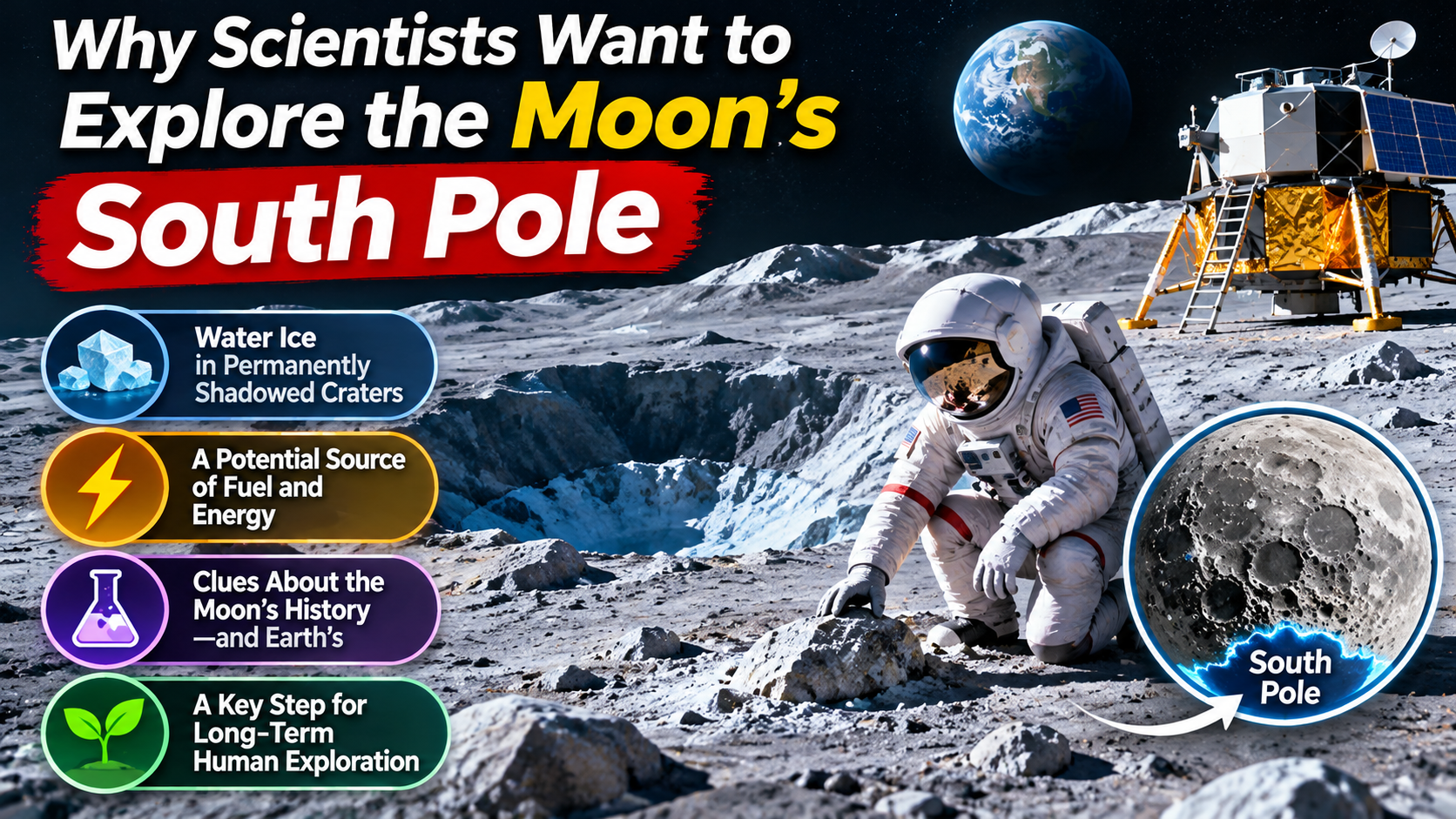
For most of human history, the Moon has been a familiar object in the night sky. Its bright surface, changing phases, and unmistakable presence have inspired generations of observers. Yet one of its most scientifically fascinating regions remains largely beyond direct human experience: the rugged landscape surrounding its south pole.
Unlike the relatively familiar locations explored during the Apollo missions, the lunar south polar region contains deep craters, unusual lighting conditions, intensely cold environments, and evidence of frozen water. These characteristics make it an extraordinary destination for researchers interested in the history of the solar system and the future of space exploration.
Scientists are particularly interested in the possibility of accessing water ice, examining ancient geological material, and developing technologies that could allow humans to live beyond Earth for extended periods.
The region offers an opportunity to transform lunar exploration from brief visits into a more sustained scientific and engineering endeavor. However, reaching it safely and working within its extreme environment will require considerable innovation.
The Moon’s small tilt creates unusual patterns of sunlight near its poles.
The Moon preserves geological evidence from the early solar system.
Some permanently shadowed locations can reach temperatures near or below this level.
The Moon provides a relatively accessible location for developing deep-space technologies.
A Landscape Unlike Anywhere Humans Have Visited
The Moon’s south pole is not simply another location on its surface. Its physical environment differs significantly from the lower-latitude regions where astronauts previously landed.
Earth experiences seasons because its rotational axis is tilted by approximately 23.5 degrees. The Moon’s axis, measured relative to the plane of Earth’s orbit around the Sun, has a much smaller tilt of roughly 1.5 degrees. This means sunlight reaches the lunar poles at extremely shallow angles.
Instead of rising high overhead, the Sun appears close to the horizon. Mountains and crater rims can interrupt this low-angle sunlight, leaving nearby depressions in extended or permanent darkness.
Certain elevated locations receive sunlight for substantial portions of the lunar year, while the interiors of neighboring craters may never receive direct sunlight at all. This dramatic contrast creates one of the most interesting environments available for planetary research.
Conceptual illustration of sunlight reaching elevated terrain while a deep crater floor remains in shadow. Not drawn to scale.
Scientists refer to locations that never receive direct sunlight as permanently shadowed regions, or PSRs. Their unusually cold conditions allow certain substances to remain frozen for extended periods, making them natural laboratories for investigating planetary processes.
Why Water Ice Is Such an Important Discovery
Water is one of the most valuable resources for any long-duration human mission. Every astronaut requires drinking water, and additional supplies are necessary for hygiene, food preparation, and various life-support functions.
Transporting everything from Earth is technically demanding because every additional kilogram increases the requirements of a space mission. Discovering a usable local water supply could therefore influence the way future expeditions are designed.
Evidence gathered by lunar spacecraft indicates that water ice exists in some polar shadowed regions. However, scientists still need to establish how much is present, how deeply it is buried, how it is distributed, and whether extracting it is practical.
Drinking Water
Extracted ice could potentially be purified and used to support astronauts. A dependable local supply might reduce the amount of water transported from Earth.
Breathable Oxygen
Water molecules contain oxygen. Through electrolysis, appropriately designed equipment could separate water into hydrogen and oxygen for further use.
Potential Rocket Propellant
Hydrogen and oxygen obtained from water could potentially support certain propulsion systems after extensive processing, storage, and technical preparation.
Long-Term Habitation
Water could contribute to recycling systems, controlled agricultural experiments, and other infrastructure needed for extended stays on the lunar surface.
Where Might Lunar Water Have Come From?
There are several possible explanations for the presence of water on the Moon. Asteroids and comets may have delivered water-bearing material during impacts. Hydrogen carried by the solar wind may also participate in reactions involving oxygen-bearing minerals on the lunar surface.
Some water may originate from processes involving the Moon’s interior. Determining the relative importance of these possible sources requires careful chemical analysis.
Water molecules released at warmer locations can sometimes migrate across the lunar surface. Those that reach sufficiently cold environments may become trapped, although radiation and small impacts can also disturb or remove frozen material.
Finding evidence of frozen water is different from establishing a commercially or operationally useful supply. Extraction in extreme cold, purification, energy consumption, and equipment reliability remain important unresolved questions.
Ancient Rocks Could Reveal the Solar System’s Past
Earth is a geologically active planet. Erosion, volcanic activity, weather, and the movement of tectonic plates continually reshape its surface. Many traces of its earliest history have consequently been altered or destroyed.
The Moon preserves a different kind of geological record. Without Earth’s active weather systems and plate tectonics, impact structures and ancient rock formations can remain recognizable for extraordinarily long periods.
The broader southern lunar hemisphere includes the South Pole-Aitken basin, an enormous impact structure approximately 2,500 kilometers across. Its formation may have exposed or redistributed materials from deep within the Moon.
Investigating these materials could help researchers understand how the lunar crust developed, how its interior evolved, and how large impacts influenced the early history of rocky planets.
Learning From Ancient Impact Events
During the early history of the solar system, rocky planets and moons experienced numerous collisions with smaller objects. Dating lunar rocks associated with these events allows scientists to reconstruct aspects of that history.
Different geological interpretations can produce different explanations of when major impacts occurred and how frequently they happened. Samples collected from previously unexplored southern terrain could provide independent evidence for evaluating those interpretations.
Frozen Deposits as Historical Records
Polar ice may preserve information beyond the history of the Moon itself. If deposits accumulated over long periods and retained their chemical characteristics, they could contain traces of material transported through the inner solar system.
Researchers would need to examine whether those deposits remained relatively undisturbed or were repeatedly mixed by impacts and radiation. Establishing the age and origin of the ice would be essential before interpreting it as a chronological record.
Why Returning Samples Matters
Laboratories on Earth contain analytical instruments that are much larger and more sophisticated than many instruments carried aboard spacecraft. Carefully preserved lunar samples could be studied repeatedly using new techniques, allowing scientific discoveries to continue long after a mission concludes.
Unusual Sunlight Could Support Longer Missions
Reliable electricity is fundamental to operating spacecraft, scientific instruments, communication systems, and human habitats.
For many locations away from the lunar poles, the cycle of daylight and darkness presents a substantial engineering challenge. A lunar daylight period lasts approximately two Earth weeks, followed by a similarly long night.
Solar-powered equipment must therefore store sufficient energy to survive extended periods without sunlight or rely on an alternative energy source.
Some elevated locations near the south pole experience more favorable illumination patterns. By carefully selecting sites along certain ridges or crater rims, engineers may be able to reduce the duration of darkness and improve the availability of solar power.
| Environmental Factor | Lower Lunar Latitudes | South Polar Region |
|---|---|---|
| Sunlight | Extended day and night cycles | Low-angle light with highly variable illumination |
| Solar power | Long-duration energy storage may be needed | Some elevated locations offer extended illumination |
| Water resources | Water may exist in certain minerals and other forms | Evidence of ice in some permanently shadowed areas |
| Terrain | Includes extensive plains and rugged highlands | Numerous craters, steep slopes, and ridges |
| Temperature | Strong day-to-night variation | Extreme differences between illuminated and shadowed areas |
Extended sunlight is not equivalent to guaranteed continuous electricity. Local terrain, seasonal lighting variations, dust accumulation, and equipment orientation must all be considered.
Engineers may combine solar panels with batteries, distributed power networks, and other energy systems. The aim would be to create reliable infrastructure rather than depend on a single source of electricity.
Why Exploring the Region Is So Difficult
The characteristics that make the south pole scientifically attractive also make it technically challenging. A mission must accomplish its research objectives while surviving conditions that can damage equipment, complicate navigation, and restrict access to important geological sites.
Extreme Temperatures
Equipment entering permanently shadowed craters must tolerate intense cold. Batteries, electronic components, moving parts, and scientific instruments may require specialized heating and insulation.
Rugged Terrain
Steep slopes, loose surface material, large rocks, and irregular crater walls complicate landing and rover operations. Detailed terrain mapping is essential for identifying safe routes.
Abrasive Lunar Dust
Fine particles of lunar regolith can accumulate on equipment, interfere with mechanisms, scratch surfaces, and reduce the performance of exposed optical or thermal systems.
Communication Limitations
Mountains and crater walls may obstruct direct radio communication with Earth. Relay satellites and carefully positioned communication infrastructure could help maintain reliable connections.
Navigation in Darkness
Long shadows and dark crater interiors can make visual navigation difficult. Specialized cameras, radar, lidar, and autonomous navigation systems may help spacecraft and rovers identify hazards.
Radiation Exposure
The Moon lacks Earth’s protective atmosphere and global magnetic field. Long-duration missions must manage exposure to solar energetic particles and galactic cosmic radiation.
These problems encourage the development of technologies that might eventually prove useful on other planetary bodies. A rover capable of operating in a dark lunar crater, for example, could contribute engineering knowledge relevant to future robotic exploration in similarly challenging environments.
How Earlier Missions Changed Our Understanding
Scientific interest in the lunar poles has accumulated through decades of research. Observations from orbiting spacecraft, controlled impact experiments, and robotic surface missions have gradually improved our understanding of the region.
The Apollo Lunar Landings
The Apollo program returned extensive rock and soil samples from the Moon. These collections transformed planetary geology, although the crewed missions did not explore the south polar region.
Lunar Prospector
Measurements of neutrons escaping the lunar surface revealed evidence of elevated hydrogen concentrations near the poles, encouraging further investigation into the possibility of frozen water.
Chandrayaan-1
India’s first lunar mission carried instruments that provided important evidence of water-related chemical signatures on the Moon. Its observations challenged earlier assumptions about a uniformly dry lunar surface.
LRO and LCROSS
NASA’s Lunar Reconnaissance Orbiter began detailed lunar mapping. The LCROSS impact experiment investigated material excavated from Cabeus crater, providing direct evidence of water within the polar environment.
ShadowCam Begins Lunar Observations
Carried aboard South Korea’s Danuri lunar orbiter, ShadowCam was designed to capture detailed images of exceptionally dark lunar terrain using faint reflected light.
Chandrayaan-3
India successfully landed a spacecraft in the Moon’s southern high-latitude region. Its lander and rover conducted surface experiments, providing valuable experience for future exploration.
Robotic Surveys and Crewed Expeditions
Future lunar exploration programs aim to investigate polar resources, collect geological samples, demonstrate advanced technologies, and gradually establish the capabilities needed for extended surface operations.
Each mission contributes a different piece of information. Orbital measurements provide regional context, while surface missions investigate individual locations in greater detail. Combining these approaches allows researchers to evaluate potential landing sites and identify unanswered scientific questions.
Could the South Pole Support a Future Lunar Base?
Establishing a sustained human presence on the Moon would represent a major departure from earlier exploration strategies. Instead of carrying every necessary resource for brief visits, future missions might gradually develop infrastructure that supports repeated expeditions.
Potential facilities could include habitats, scientific laboratories, electricity generation systems, communication stations, storage areas, and equipment for investigating local materials.
One important concept is in-situ resource utilization, commonly abbreviated as ISRU. It describes the practice of using materials found at an exploration destination rather than transporting every resource from Earth.
From Scientific Discovery to Practical Infrastructure
A realistic approach to local resource utilization would begin with detailed surveying. Scientists would identify promising deposits, collect samples, measure their composition, and evaluate extraction methods.
Small demonstration systems could then test whether useful substances can be recovered consistently under lunar conditions. Larger facilities would only become reasonable if those demonstrations establish sufficient reliability, safety, and efficiency.
The long-term objective is not complete independence from Earth immediately. It is a gradual reduction in the amount of material that must be transported to sustain exploration.
Using Lunar Soil as a Construction Material
The Moon’s surface is covered by a layer of fragmented rock and fine particles known as regolith. Researchers are investigating whether this material can be processed into construction components, landing surfaces, protective barriers, or other useful structures.
Local material might also be placed around habitats to help reduce radiation exposure and provide protection against small impacts. However, construction techniques that work on Earth cannot simply be transferred to the Moon without modification.
Vacuum conditions, reduced gravity, fine dust, and limited energy supplies introduce engineering problems that must be addressed through experiments and technology demonstrations.
Preparing for Human Exploration Beyond the Moon
The Moon provides an unusually valuable testing environment because it combines the challenges of living beyond Earth with a comparatively accessible distance from our planet.
While travel to Mars generally requires months, lunar missions can reach their destination in days. Communication signals also take much less time to travel between Earth and the Moon than between Earth and Mars.
This makes the Moon a suitable environment for evaluating technologies before committing to expeditions farther into the solar system.
Future lunar operations could provide practical experience in maintaining life-support systems, repairing equipment, managing limited resources, operating autonomous robots, and coordinating scientific work in an isolated environment.
Nevertheless, the Moon and Mars have important differences. Mars has an atmosphere, different gravity, distinct geological processes, and different environmental conditions. Equipment developed for lunar exploration would require adaptation before being used there.
The most transferable lessons may concern the broader principles of operating reliable systems, managing supplies, responding to equipment failures, and maintaining human health during extended periods away from Earth.
Protecting a Scientifically Valuable Environment
As interest in lunar exploration increases, scientists must also consider how human activity could alter the environments they wish to study.
Rocket exhaust, disturbed dust, equipment emissions, and the movement of vehicles could introduce foreign materials into otherwise relatively undisturbed locations. This is particularly important when investigating trace chemical substances in polar ice deposits.
Researchers may therefore need to establish carefully controlled sampling sites and develop procedures that minimize contamination. Recording environmental conditions before major operations begin could help distinguish natural materials from those introduced by spacecraft.
International cooperation can also support responsible exploration. Sharing scientific measurements, coordinating activities, and developing compatible technical standards may reduce unnecessary interference while increasing the value of individual missions.
The south pole is both a potential destination for infrastructure and an important geological archive. Protecting its scientific value while investigating practical resources will require careful planning.
Frequently Asked Questions
Why is the Moon’s south pole more interesting than many other regions?
It combines evidence of frozen water, ancient geological terrain, unusual illumination patterns, and opportunities for developing infrastructure. Few lunar regions offer the same combination of scientific and practical possibilities.
Is there definitely water at the lunar south pole?
Spacecraft measurements and impact experiments provide evidence of water ice in certain polar locations. Its precise abundance, distribution, accessibility, and suitability for extraction remain subjects of ongoing research.
Does the south pole receive sunlight?
Yes. Certain elevated locations receive sunlight for substantial periods. However, the interiors of some deep craters never receive direct sunlight because of the Moon’s small axial tilt and local terrain.
Can humans breathe on the Moon?
No. The Moon does not possess a breathable atmosphere. Astronauts require spacesuits and pressurized habitats equipped with appropriate life-support systems.
Could lunar ice be converted into rocket fuel?
Potentially. Water can be separated into hydrogen and oxygen, which may be used in certain propulsion systems. Practical production would require extraction equipment, electricity, processing facilities, and suitable storage systems.
Did Apollo astronauts explore the lunar south pole?
No. The Apollo surface missions explored locations at lower lunar latitudes. The immediate south polar region represents a substantially different environment for future human expeditions.
Did Chandrayaan-3 land exactly at the south pole?
No. Chandrayaan-3 landed at approximately 69 degrees south latitude, within the Moon’s southern high-latitude region rather than at the geographical south pole itself.
Why are some lunar craters permanently dark?
Sunlight reaches the polar regions at very shallow angles. Elevated crater rims and surrounding terrain can continuously block direct sunlight from reaching certain crater floors.
Could people live permanently on the Moon?
A sustained human presence may eventually be possible with suitable habitats, reliable energy, radiation protection, transportation, and life-support systems. Significant engineering and logistical challenges must still be resolved.
Is the lunar north pole scientifically important too?
Yes. The north polar region also contains permanently shadowed environments and evidence of frozen materials. Researchers are interested in both poles, although several major exploration programs emphasize the southern region.
A New Chapter in Lunar Exploration
The Moon’s south pole brings together several of the most compelling questions in modern planetary science. Its frozen deposits could reveal how water moved through the early solar system, while ancient rocks may provide evidence about events that shaped the Moon and neighboring planets billions of years ago.
Its distinctive lighting conditions and potential resources also offer opportunities to develop new approaches to human exploration. Yet the region’s scientific promise must be balanced against its exceptional technical challenges.
Future spacecraft, robotic explorers, and human expeditions will gradually reveal how accessible its resources are and what its geological records can teach us. Progress will depend on careful measurements, reliable engineering, and responsible exploration rather than assumptions about what might exist beneath the surface.
The next major chapter of lunar exploration is therefore about more than reaching a new destination. It is about learning how to investigate, understand, and operate within an environment beyond Earth while preserving the scientific discoveries that make the journey worthwhile.