APOLLO LUNAR ARCHIVE / PLANETARY EXPLORATION
Bringing Pieces of the Moon Back to Earth
How Apollo astronauts gathered lunar rocks and soil, protected their scientific samples, and transported them across nearly 240,000 miles of space.
When Apollo astronauts stepped onto the Moon, their mission involved far more than planting a flag or taking photographs.
One of their most important scientific responsibilities was collecting rocks and soil that could be studied in laboratories on Earth.
These samples offered scientists a direct opportunity to investigate the Moon’s geological history, surface conditions, and relationship to the early solar system.
Between 1969 and 1972, six Apollo missions successfully landed astronauts on the lunar surface and returned geological material to Earth.
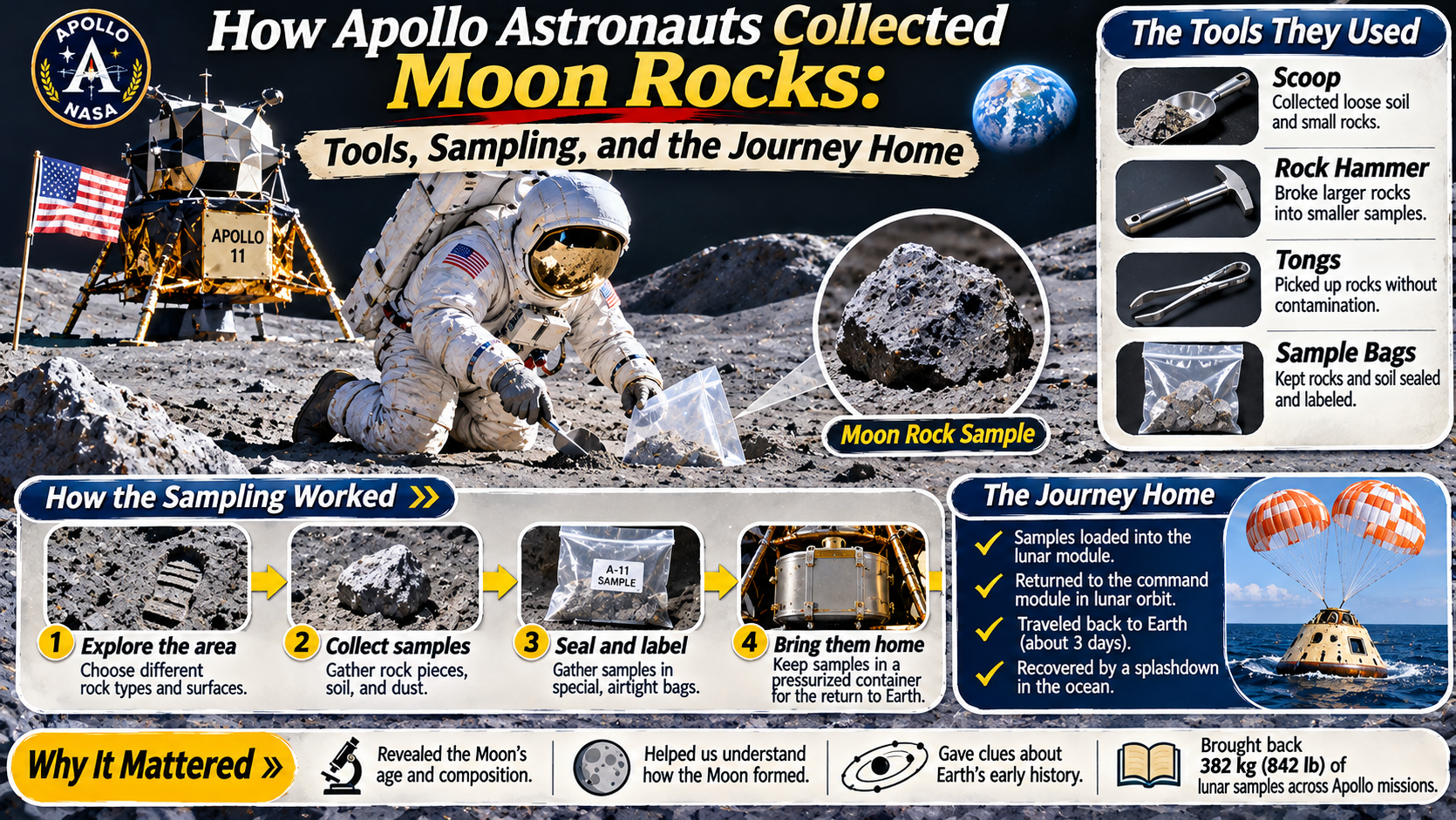
Working in bulky spacesuits, astronauts used specialized tools to collect surface rocks, scoop loose soil, and extract samples from beneath the lunar surface.
Each specimen had to be documented, packaged, and transported through a complicated return journey.
The Apollo lunar sample program transformed planetary science by bringing approximately 382 kilograms—about 842 pounds—of Moon rocks, soil, and related material back to Earth.
The story of these samples reveals how engineering, astronaut training, and geological research came together during humanity’s first crewed exploration of another world.
Why Scientists Wanted Rocks from the Moon
Before Apollo, scientists studied the Moon primarily through telescopes, photographs, and observations made by robotic spacecraft.
These methods revealed important surface features, including impact craters, mountains, and broad dark plains known as maria.
However, photographs alone could not provide complete information about the composition and age of lunar materials.
Physical samples allowed researchers to examine minerals, measure chemical compositions, and determine geological ages using laboratory techniques.
Scientists hoped lunar rocks would help answer several major questions.
How old was the Moon’s surface? What processes created its volcanic plains? How frequently had large impacts occurred? What could lunar materials reveal about the early history of Earth and the solar system?
Returning samples was therefore a central scientific objective of the Apollo lunar landing program.
How Astronauts Prepared for Lunar Geology
Astronauts did not arrive on the Moon without geological preparation.
Before their missions, crews participated in field training designed to help them recognize rock types, describe geological features, and collect useful specimens.
Training locations included volcanic landscapes, impact-related geological sites, and other environments with features relevant to lunar exploration.
Geologists worked with astronauts to develop practical observation and sampling techniques.
The crews learned to describe the location, appearance, and surrounding conditions of collected rocks.
They also practiced using tools while wearing equipment that simulated some of the movement restrictions of lunar spacesuits.
These preparations became increasingly important as later Apollo missions placed greater emphasis on geological exploration.
Apollo 17 included Harrison Schmitt, a trained geologist who became the first professional scientist to walk on the Moon.
The Specialized Tools Used to Collect Moon Rocks
Collecting geological samples on the Moon required equipment designed for an unusual environment.
Astronauts had to work in reduced gravity while wearing pressurized gloves and spacesuits that limited flexibility.
Ordinary laboratory equipment was not always practical.
Engineers developed sampling tools with long handles, specialized grips, and mechanisms suited to astronaut operations.
APOLLO FIELD EQUIPMENT / SAMPLE COLLECTION
Used to break or chip rock specimens and expose fresh surfaces for examination and collection.
Collected loose lunar soil, small rock fragments, and other surface material.
Allowed astronauts to pick up rocks without bending down as frequently.
Collected cylindrical samples from beneath the surface to preserve information about soil layers.
Held collected materials and helped preserve their identity and condition during transport.
Collecting Rocks from the Lunar Surface
During lunar surface excursions, astronauts examined the landscape and selected rocks that could provide useful geological information.
They collected specimens from areas such as crater rims, slopes, and relatively flat surfaces.
Some rocks were gathered individually, while others were collected as part of broader sampling activities.
Astronauts often photographed a specimen before removing it.
They described its appearance and surrounding terrain through voice communications recorded during the mission.
This documentation helped scientists understand the original geological context of the material.
After collection, rocks were placed in designated bags or sample containers.
Careful labeling and documentation were essential because a rock’s scientific value depends partly on knowing where it came from.
Lunar Regolith: Collecting the Moon’s Soil
The Moon’s surface is covered in many places by a layer of fragmented material known as regolith.
Lunar regolith includes fine particles, rock fragments, and material produced through repeated impacts and other surface processes.
Unlike ordinary terrestrial soil, lunar regolith does not develop primarily through biological activity.
It is largely the result of physical and chemical processes operating on an airless planetary surface.
Astronauts collected regolith using scoops and other sampling devices.
These samples helped scientists investigate the effects of meteorite impacts, space weathering, and long-term exposure to the space environment.
Regolith also contains information about the processes that gradually modify the lunar surface.
Why Core Samples Were Especially Valuable
Surface samples provide information about exposed lunar material, but scientists also wanted to understand what lay beneath the uppermost layer.
Core tubes allowed astronauts to collect material from below the surface.
By driving a tube into the regolith, astronauts could obtain a cylindrical sample containing material from different depths.
These samples sometimes preserved information about the sequence of deposited layers.
Scientists could examine changes in particle size, composition, and other characteristics through the core.
Some Apollo missions also collected deeper cores using specialized drilling equipment.
Core samples were particularly useful for studying the accumulation and modification of lunar regolith over time.
LUNAR GEOLOGY / RESEARCH NOTE
A Rock Reveals Its Composition. A Core Sample Can Also Preserve Clues About the Sequence of Material Beneath the Surface.
Both types of samples helped scientists reconstruct the geological history of the Moon.
How Astronauts Documented Their Samples
Collecting a rock was only one part of the scientific process.
Astronauts also needed to record where each specimen was found and how it related to nearby geological features.
Mission photography provided visual documentation.
Voice descriptions recorded observations about color, texture, size, and location.
Sampling plans helped organize geological work during limited surface exploration time.
Later missions benefited from improved equipment, longer surface stays, and expanded exploration capabilities.
The Lunar Roving Vehicle used during Apollo 15, 16, and 17 allowed astronauts to travel farther from their landing sites.
This increased access to geological locations and helped crews collect a wider variety of specimens.
How Lunar Samples Were Protected from Contamination
Scientists wanted lunar materials to arrive on Earth in a condition suitable for careful laboratory analysis.
Contamination from spacecraft materials, human activity, or Earth’s environment could complicate scientific measurements.
Astronauts used specialized sample bags and containers to reduce unwanted exposure.
Some specimens were placed in sealed containers designed to preserve their condition more carefully.
Not every Apollo sample was protected to the same degree, and collection procedures evolved throughout the program.
Researchers documented handling histories so that possible contamination could be considered during later analysis.
After the samples returned to Earth, specialized laboratory procedures helped protect them from additional contamination.
The Journey Home: From the Moon to Earth
After completing their lunar surface activities, astronauts returned to the Lunar Module.
Collected rocks, soil, and other materials were brought aboard and prepared for the return journey.
The ascent stage of the Lunar Module launched from the Moon and rendezvoused with the Command and Service Module in lunar orbit.
The crew transferred the samples into the Command Module before the Lunar Module was discarded.
The spacecraft then began its journey back toward Earth.
During atmospheric reentry, the Command Module protected the crew and cargo from the intense heating associated with returning from space.
Parachutes slowed the capsule before splashdown in the ocean.
Recovery teams retrieved the astronauts and spacecraft, allowing the lunar samples to enter the next stage of their scientific journey.
APOLLO SAMPLE RETURN / MISSION SEQUENCE
Astronauts gather and document geological specimens.
Materials are placed into designated bags and containers.
The Lunar Module ascent stage returns the crew and samples to lunar orbit.
Samples move into the Command Module for the journey home.
The capsule is recovered, and samples enter controlled scientific facilities.
What Happened to Moon Rocks After They Reached Earth?
After recovery, Apollo samples were transported to specialized facilities for examination, documentation, and scientific analysis.
Early missions operated under quarantine procedures intended to address uncertainties about possible biological hazards from lunar material.
These procedures were later discontinued after evidence indicated that the Moon did not present the anticipated biological risk.
Scientists examined the samples using microscopes, chemical analysis, radiometric dating, and other laboratory methods.
Many specimens were divided into smaller portions for different investigations.
Careful records helped researchers connect laboratory results with the original lunar collection locations.
NASA continues to preserve Apollo samples for scientific research.
Some materials have remained stored for decades so that researchers can investigate them using analytical technologies developed long after the missions ended.
What Types of Rocks Did Apollo Astronauts Collect?
Apollo astronauts returned several important categories of lunar materials.
Basalt samples helped scientists investigate ancient volcanic activity on the Moon.
Many lunar highland rocks contain minerals such as plagioclase feldspar and provide information about the Moon’s early crust.
Breccias consist of rock fragments that became joined together through impact-related or other geological processes.
Regolith samples reveal the effects of countless impacts and prolonged exposure to the space environment.
These different materials allowed scientists to investigate several chapters of lunar history.
Apollo Lunar Sample Collection by Mission
| Mission | Year | Approximate Sample Mass |
|---|---|---|
| Apollo 11 | 1969 | 21.6 kg |
| Apollo 12 | 1969 | 34.3 kg |
| Apollo 14 | 1971 | 42.8 kg |
| Apollo 15 | 1971 | 77.3 kg |
| Apollo 16 | 1972 | 95.7 kg |
| Apollo 17 | 1972 | 110.5 kg |
The later Apollo missions generally returned larger sample collections because of expanded scientific objectives, longer surface activities, and improved exploration capabilities.
What Moon Rocks Revealed About Lunar History
Laboratory studies of Apollo samples produced major advances in planetary science.
Radiometric dating showed that many lunar rocks are billions of years old.
Basalt samples demonstrated that volcanic activity once produced extensive lava flows on the Moon.
Highland samples provided evidence about the formation and early evolution of the lunar crust.
Impact-related rocks helped researchers study the history of collisions affecting the Moon’s surface.
Chemical and isotopic measurements also contributed to research into the Moon’s origin.
The giant-impact hypothesis, which proposes that the Moon formed following a major collision involving the early Earth, has been developed and refined using multiple lines of evidence, including lunar samples.
Scientists continue debating important details of lunar formation and evolution.
Why Apollo Moon Rocks Are Still Important Today
More than five decades after the final Apollo landing, lunar samples remain scientifically valuable.
Modern instruments can measure chemical and isotopic properties with greater precision than many tools available during the original missions.
Researchers can investigate tiny sample portions while preserving much of the original material.
Some previously unopened samples have been examined using modern laboratory techniques.
These investigations provide new information about lunar geology and the processes that shaped the early solar system.
Apollo samples also help scientists interpret observations from modern lunar orbiters and robotic missions.
The collection therefore continues to connect historical human exploration with contemporary planetary research.
Frequently Asked Questions
How many Moon rocks did Apollo astronauts bring back?
The six successful Apollo lunar landing missions returned approximately 382 kilograms, or 842 pounds, of lunar rocks, soil, and related material.
What tools did astronauts use to collect Moon rocks?
They used geological hammers, scoops, tongs, core tubes, and specialized sample bags and containers.
Why did astronauts collect lunar soil?
Lunar regolith contains evidence of impact processes, space weathering, and the long-term evolution of the Moon’s surface.
How were Moon rocks transported to Earth?
Samples were carried from the lunar surface into the Lunar Module, transferred to the Command Module in lunar orbit, and returned to Earth with the astronauts.
Where are Apollo Moon rocks stored today?
NASA preserves much of the Apollo collection in specialized facilities, including the Lunar Sample Laboratory Facility at Johnson Space Center.
What did scientists learn from Apollo Moon rocks?
They learned about the Moon’s ancient crust, volcanic activity, impact history, and chemical composition.
Are Apollo Moon rocks still studied?
Yes. Scientists continue examining Apollo samples using modern laboratory instruments and analytical techniques.
Final Thoughts
The Apollo lunar sample program was one of the most significant achievements in the history of planetary exploration.
Astronauts used specialized equipment to collect rocks and soil while working under challenging conditions on the Moon.
Careful documentation preserved information about where specimens were found and how they related to the surrounding landscape.
After collection, the samples traveled from the lunar surface to lunar orbit, across space, and finally back to Earth.
Laboratory investigations transformed these materials into evidence about the Moon’s geological past.
Decades later, the same collection continues to support new discoveries.
The Apollo Moon rocks demonstrate how a relatively small amount of carefully collected material can provide an extraordinary record of another world.